 ChessMess
Chess in India: from chaturanga to world champions
India gave the world chess. The whole story: chaturanga, shatranj at Indian courts, Sultan Khan, Anand, Gukesh and India's 100 grandmasters.
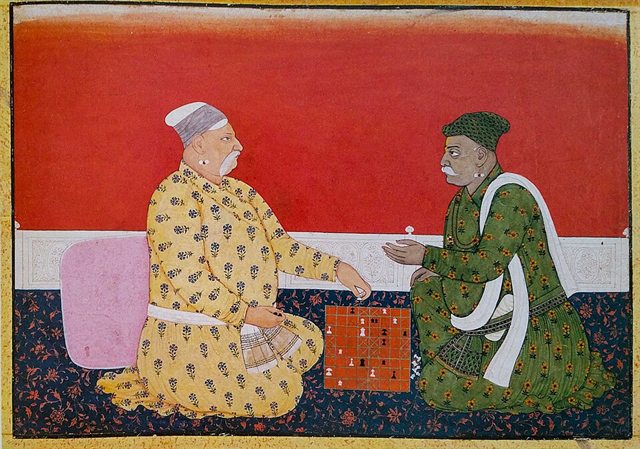
Chess was born in India. Its ancestor, chaturanga, was played there by around the 6th century CE, travelled west as shatranj, and later came home in Persian and then European forms. Today India is one of the strongest chess nations on earth, with a world champion, Gukesh Dommaraju, two Olympiad gold medals from 2024 and, as of November 2026, 100 grandmasters.
The birthplace of chess
The oldest clear evidence of chess comes from India. Chaturanga was a war game with four kinds of soldiers: elephants, chariots, horses and foot soldiers. The full story, with the legends, is in Who invented chess?
Shatranj comes home
From India the game went to Persia and the Arab world, where it was called shatranj (read Chess in Persia and the Islamic world). With Muslim rulers it came back to India from around the 12th century, bringing Persian words with it. In Hindi and Urdu chess is still called shatranj, and checkmate is shah mat.
Names change from region to region, but these Hindi and Urdu names are common:
| Piece | Hindi or Urdu name | Meaning |
|---|---|---|
| King | raja, badshah | king |
| Queen | wazir (also rani or mantri) | minister (or queen) |
| Rook | haathi (in Urdu also rukh) | elephant |
| Bishop | oont | camel |
| Knight | ghoda | horse |
| Pawn | pyada | foot soldier |
Notice the swap. In India the elephant became the rook, while in Europe the old elephant piece became the bishop.
Until the 19th century many Indians also played with their own rules. Pawns could not move two squares at the start. There was no normal castling; instead, a king that had not yet been checked could jump once like a knight. And a pawn that reached the far side became the piece that had started on that square.
Chess at Indian courts
In India chess was a game of kings from the start. Around 625 CE the court poet Banabhatta used its name in a book praising King Harsha, and the Persian Book of Chess says the game reached Persia as a royal gift and challenge from an Indian ruler. Much later, painters in the hill kingdoms of the Himalayan foothills showed nobles at the board. The painting above, made in Guler (in today's Himachal Pradesh) around 1720 to 1725 and credited to the artist Pandit Seu, shows Mian Gopal Singh of Guler playing Pandit Dinamani Raina. Look closely: the board is all one colour, as Indian boards often were.
The Chess Players: Premchand and Satyajit Ray
In 1924 the writer Premchand published a short story, Shatranj ke Khilari (The Chess Players), in Hindi, with an Urdu version called Shatranj ki Bazi. It is set in Lucknow in 1856, as the British East India Company takes over the kingdom of Awadh from Nawab Wajid Ali Shah. Two rich noblemen, Mirza Sajjad Ali and Mir Roshan Ali, are so lost in their games that they ignore their families while their kingdom falls.
In 1977 Satyajit Ray turned the story into the film Shatranj Ke Khilari, his only full-length feature film in Hindi, with Sanjeev Kumar and Saeed Jaffrey as the two friends. It won the National Film Award for Best Feature Film in Hindi.
Calcutta and the "Indian Defence"
In 1848 a member of the Calcutta Chess Club heard of a Brahmin from the countryside who had never lost a game. His name was Moheschunder Bannerjee. He was brought to Calcutta (now Kolkata), where the strong Scottish player John Cochrane, a lawyer there, played him regularly for years. Hundreds of their games survive.
Bannerjee had grown up with Indian rules, where pawns never moved two squares. So he liked to develop his bishops on the long diagonals, behind pawns on g6 or b6, instead of rushing pawns into the centre. European players learned these set-ups from him and other Indian players, and they became known as the "Indian" defences. Today's King's Indian Defence and Queen's Indian Defence still carry the name. In one game, usually dated 1855, Bannerjee even used the set-up that was later named after Ernst Grünfeld, who made it famous in 1922.
Sultan Khan, the champion from Punjab
Sultan Khan (often called Mir Sultan Khan) was born in Mitha Tiwana in Punjab, then part of British India and now in Pakistan's Khushab District. Sources give his birth year as 1903 or 1905. He learned Indian chess from his father at nine and by his early twenties was the strongest player in Punjab. A wealthy landowner, Sir Umar Hayat Khan Tiwana, took him into his household, and in 1928 he won the all-India championship with eight wins and a draw.
In 1929 Sir Umar took him to England. Sultan Khan had to learn the European rules and openings quickly, yet he won the British Championship that same summer. He won it again in 1932 and 1933. Against the best players of the early 1930s his results were remarkable:
- At Hastings 1930–31 he beat the former world champion José Raúl Capablanca and finished third, behind Max Euwe and Capablanca.
- In 1931 he won a match against Savielly Tartakower, with four wins, three losses and five draws.
- At the 1931 Olympiad in Prague, on top board for England, he scored eight wins, seven draws and only two losses. He beat Akiba Rubinstein and Salo Flohr and drew with world champion Alexander Alekhine.
- At London 1932 he tied for third place, behind Alekhine and Flohr.
The chess historians David Hooper and Ken Whyld called him "perhaps the greatest natural player of modern times".
Replay the whole game, a long and patient squeeze, on the analysis board.
In December 1933 Sir Umar took him home. He played little chess after that, farmed his family's land, and died in Sargodha, Pakistan, on 25 April 1966. In February 2024 FIDE, the world chess federation, made him an honorary grandmaster at a ceremony in Islamabad. His story belongs to the chess history of both India and Pakistan.
The Anand era
The All India Chess Federation was founded in 1951, but the big breakthrough came with Viswanathan Anand. Born in 1969 in Mayiladuthurai in Tamil Nadu and raised in Chennai, he played so fast as a boy that he was called the "Lightning Kid". In 1988 he became India's first grandmaster.
Anand won the FIDE world championship in 2000. He then became undisputed world champion by winning the 2007 championship tournament in Mexico City, and defended the title in matches against Vladimir Kramnik (2008), Veselin Topalov (2010) and Boris Gelfand (2012), before losing it to Magnus Carlsen in Chennai in 2013. His success did a great deal to make chess popular across India. Read his story in Viswanathan Anand.
From one grandmaster to 100
After Anand, it took nine years for India to reach three grandmasters, and by the end of 2011 there were 25. In November 2026 Indian media reported that Anuj Shrivatri, a 22-year-old from Madhya Pradesh, had become India's 100th grandmaster, 38 years after Anand became the first.
The team results followed:
- 2014: India's first Olympiad medal, a bronze in the open section in Tromsø, Norway.
- 2022: India hosted its first Chess Olympiad, at Mamallapuram near Chennai. The women's first team and the second open team both won bronze, and 16-year-old Gukesh won his first eight games.
- 2024: In Budapest, India won both the open and the women's gold medals, its first Olympiad titles. The open team scored 21 out of 22 possible match points, a record.
- 2026: In Samarkand, Uzbekistan, India took silver in the open section and bronze in the women's.
India also hosted the 2025 FIDE World Cup in Goa.
Gukesh, world champion
Gukesh Dommaraju was born in Chennai on 29 May 2006 and became a grandmaster at 12. In April 2024 he won the Candidates Tournament in Toronto, the youngest player ever to do so. In December 2024 he beat Ding Liren of China 7½–6½ in Singapore and, at 18, became the youngest undisputed world champion in history. As of November 2026 he is due to defend his title against Javokhir Sindarov of Uzbekistan in a match near Geneva, Switzerland, with the first game set for 24 November. Read more in Gukesh Dommaraju.
India's leading women
- Koneru Humpy became India's first woman grandmaster in 2002, at 15. She won the world rapid championship in 2019 and again in 2024.
- Harika Dronavalli became the second Indian woman grandmaster, in 2011.
- Vaishali Rameshbabu, the older sister of grandmaster Praggnanandhaa, became the third in 2023. In April 2026 she won the Women's Candidates Tournament in Cyprus, earning a world title match against China's Ju Wenjun.
- Divya Deshmukh won the 2025 Women's World Cup in Batumi, Georgia, at 19, beating Humpy in the tiebreaks of an all-Indian final. The win made her a grandmaster: India's 88th, and the fourth Indian woman to earn the title.
The game that left India as chaturanga some 1,500 years ago has come home in style.
Sources
- Sultan Khan (chess player), Wikipedia
- Honorary grandmaster title posthumously awarded to Sultan Khan, Chess.com, February 2024
- Edward Winter, John Cochrane, Chess Notes
- Shatranj Ke Khilari (The Chess Players), Wikipedia
- Chess in India, Wikipedia
- India gets 100th chess grandmaster in Anuj Shrivatri, ESPN, 8 November 2026
- Divya Deshmukh wins the 2025 FIDE Women's World Cup, Chess.com, July 2025
- The young king faces his toughest challenge, FIDE, 7 November 2026
Checked in November 2026.
Questions and answers
- Was chess invented in India?
- Yes, according to most historians. The earliest clear evidence of chess is chaturanga, played in India by around the 6th century CE. Persian and Arab writers of the early Middle Ages also said the game came from India.
- Who was India's first grandmaster?
- Viswanathan Anand became India's first grandmaster in 1988. He later became world champion, winning the FIDE title in 2000 and the undisputed title in 2007, which he held until 2013.
- How many grandmasters does India have?
- In November 2026 Indian media reported that Anuj Shrivatri had become India's 100th grandmaster, 38 years after Anand became the first.
- Who was Sultan Khan?
- Sultan Khan was a chess player from Punjab, born in what is now Pakistan. Between 1929 and 1933 he won the British Championship three times and beat players such as Capablanca, Rubinstein and Flohr. FIDE made him an honorary grandmaster in 2024.
- What is chess called in Hindi and Urdu?
- Chess is called shatranj in Hindi and Urdu, from the Persian name of the game. Checkmate is shah mat, and common piece names include raja or badshah (king), wazir (queen), haathi (rook), oont (bishop), ghoda (knight) and pyada (pawn).
Play free now — no sign-up needed