 ChessMess
Chess in medieval Europe: how the game arrived and changed
How chess reached Europe around the 10th century through Spain, Italy and Byzantium, won over kings and monks, and turned the vizier into a queen.
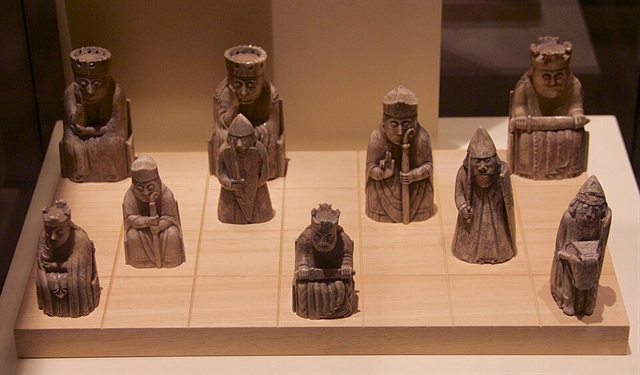
Chess reached Europe around the 10th century. It came from the Islamic world through Muslim Spain (Al-Andalus), through Sicily and southern Italy, and through the Byzantine Empire, and by about the year 1000 it was known across much of the continent. Over the next five hundred years Europeans gave the pieces new shapes and names, coloured the board in light and dark squares, and in the end turned a slow game into modern chess.
How chess arrived
Arab players had enjoyed shatranj since the conquest of Persia in the 7th century (read Chess in Persia and the Islamic world). By the 10th century Muslims had carried the game to North Africa, Sicily and Al-Andalus. Further east, the Byzantine Greeks played it as zatrikion, and traders brought it to Russia along the Volga river, perhaps as early as the 9th century.
Spain and Portugal kept a name from Arabic: ajedrez in Spanish and xadrez in Portuguese. Most of Europe instead named the game after the Persian word shah, "king": scacchi in Italian, échecs in French, Schach in German, and chess in English.
The first European mentions
The oldest European text about chess is a Latin poem now called the Einsiedeln Verses (Versus de scachis). It is kept at Einsiedeln Abbey in Switzerland and was written down around the year 1000. It praises chess as a game with no dice, no cheating and no danger to the body, and then explains the pieces. It is also the first text to call the counsellor a queen (regina in Latin), and the first to mention a board with squares of two colours, which it says some players liked because it made the moves easier to follow. The two armies were red and white.
Other mentions follow quickly. Around 1008 Count Ermengol I of Urgell, in Catalonia, left his chessmen in his will to the convent of St Giles. A German Latin poem, Ruodlieb (around 1070), mentions the game, and so does the English scholar Alexander Neckam (around 1180).
The church: for and against
The church's attitude was mixed. In 1061 or 1062 Cardinal Peter Damian complained to the pope-elect that the Bishop of Florence had been playing chess. The bishop replied that chess was a game of skill, unlike games of chance played with dice. That argument came up again and again for centuries.
Churchmen worried because chess was often played for money and sometimes ended in violence: two 13th-century quarrels over chess in London, involving men from Essex, ended in deaths. In 1254 King Louis IX of France issued an order against gambling, but it was largely ignored, and his courtiers kept playing.
Yet church people also helped chess to spread. The Einsiedeln Verses were copied in a monastery, a count left his chessmen to a convent, and a friar used the game to preach (see below).
A game for kings and knights
From the 12th to the 15th century, chess was a favourite pastime at the courts of Europe. The writer Petrus Alfonsi listed it among the seven skills that every good knight should learn. Nobles paid for beautiful boards and pieces, which is why so many fine medieval sets survive.
The Lewis chessmen
The most famous of them are the Lewis chessmen (pictured above). They were carved between about 1150 and 1200, mostly from walrus ivory, probably in Trondheim in Norway. They were found in 1831 on the Isle of Lewis in the Outer Hebrides of Scotland. The hoard held 78 chess pieces, 14 pieces for a backgammon-type game, and a belt buckle.
They are full of character. Kings sit on thrones holding swords. Queens rest a hand on one cheek. The bishops hold a bishop's staff, and they are among the earliest chessmen ever carved as bishops. Knights ride small horses, and the rooks are standing warriors called "warders", some of them wild-eyed berserkers biting their shields. Most of the hoard is in the British Museum in London; eleven pieces are in the National Museum of Scotland in Edinburgh.
Alfonso X's Book of Games
In 1283 King Alfonso X of Castile, known as "the Wise", had a great book of games completed in his workshop in Toledo. The Libro de los juegos (Book of Games) covers chess, dice and "tables", the family of games that includes backgammon, and it is the earliest European book about chess. It was built from Arabic sources and holds more than 100 chess problems and variants, including chess for four players. Its 150 paintings show men and women, young and old, nobles and vagabonds, and Christian, Muslim and Jewish players at the board. The original is kept in the library of El Escorial, near Madrid.
Chess as a lesson in good behaviour
In the late 13th century a Dominican friar in northern Italy, Jacobus de Cessolis, preached sermons that used chess as a picture of society. In his book the pieces stand for the king, the queen, nobles and officials, and the pawns stand for working people: farmers, smiths, clothmakers and clerks, merchants, doctors, innkeepers, city guards, and finally gamblers and messengers. Each had duties, and the book explained them. It was copied and translated all over Europe; the historian H. J. R. Murray thought it was almost as popular as the Bible.
William Caxton, England's first printer, translated it into English as The Game and Playe of the Chesse. He finished his first edition in Bruges in 1474 (early 1475 by today's calendar), and it was one of the very first books printed in English. Caxton still called the bishop the "alphin", a word that comes from the Arabic alfil.
New board, new names
In shatranj every square had the same colour. In Europe the chequered pattern spread from about the 10th century. Its long lines of same-coloured squares along the diagonals made it easier, centuries later, to give the bishop and queen their long diagonal moves. In much of Asia, boards stayed plain far longer.
The pieces changed too:
- The ferz, the counsellor or vizier, became the queen. Perhaps this was simply because it stood next to the king; the historian Stephanie Coontz has argued that it reflects the real power of medieval queens. In Russian the queen is still called ferz.
- The alfil, the elephant, puzzled Europeans, who had rarely seen an elephant. Its two blunt points, meant as tusks, looked to some like a bishop's mitre (his tall hat) and to others like a fool's cap. So English has the bishop and French has the fou, the "fool". Spanish still calls it the alfil.
- The rukh, the chariot, kept its Persian name: rook.
- The horse became a knight, a mounted warrior.
- The foot soldier became the pawn, from a Latin word for a soldier on foot.
See how they move now in the lessons on the bishop and the queen, and read the whole story of their names in Chess pieces: names and history.
The end of medieval chess
Medieval chess was slow, and some games lasted for days. Players tried to speed it up. Pawns were sometimes allowed to move two squares on their first move, and the king got a one-time leap that later grew into castling. Then, between about 1475 and 1500, players in Valencia in Spain gave the queen the power to move any distance in any direction, and the bishop any distance along a diagonal. The first text that shows the new queen is a Catalan poem, Scachs d'amor, written in Valencia in 1475. People called the new game "queen's chess" or "mad queen chess". It was faster and sharper, and it spread across Europe quickly. That story continues in The birth of modern chess and How the rules of chess changed.
Sources
- Origins of chess: the Europe sections (Wikipedia)
- Versus de scachis, the Einsiedeln Verses (Wikipedia)
- Chess in early literature (Wikipedia)
- Lewis chessmen (Wikipedia)
- Libro de los juegos (Wikipedia)
- Jacobus de Cessolis (Wikipedia)
- William Caxton, The Game and Playe of the Chesse, Project Gutenberg edition
- H. J. R. Murray, A History of Chess (1913), on the Internet Archive
Checked in November 2026.
Questions and answers
- When did chess come to Europe?
- Chess reached southern Europe around the 10th century, through Muslim Spain, Sicily and Italy, and through the Byzantine Empire. By about the year 1000 it was known across much of Europe. The oldest European poem about chess, the Einsiedeln Verses, dates from around then.
- What are the Lewis chessmen?
- They are a famous group of medieval chess pieces carved mostly from walrus ivory between about 1150 and 1200, probably in Norway. They were found in 1831 on the Isle of Lewis in Scotland. Most are in the British Museum and eleven are in the National Museum of Scotland.
- How did the vizier become the queen in chess?
- In Persian and Arabic chess the piece next to the king was a counsellor or vizier that moved one square diagonally. In Europe it was renamed the queen; the Einsiedeln Verses already call it regina around the year 1000. It only got its modern long moves around 1475 in Spain.
- Why is the bishop called a bishop?
- The piece began as an elephant. Its two points, meant as tusks, looked to medieval Europeans like a bishop's mitre, so English speakers called it a bishop. French speakers saw a fool's cap and called it the fou, while Spanish kept the Arabic name alfil.
Play free now — no sign-up needed