 ChessMess
Chess in Persia and the Islamic world: chatrang and shatranj
How chess came from India to Persia as chatrang, became shatranj in the Islamic world, gave us the word checkmate and travelled on to Spain and Europe.
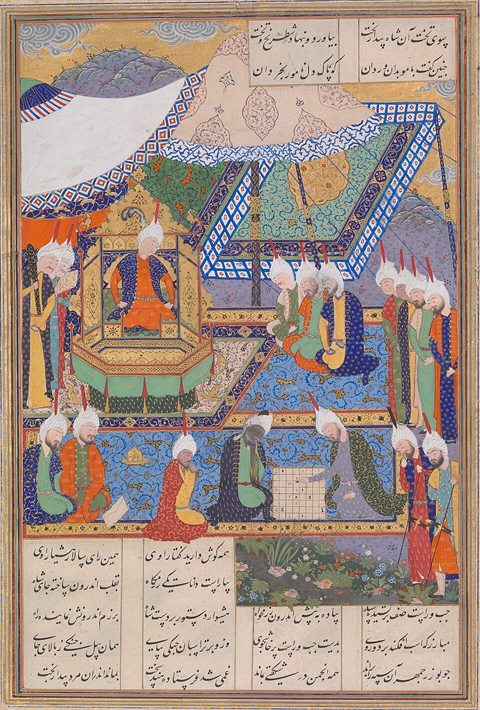
Chess came to Persia from India by the 6th century CE, where it was called chatrang. After Arab armies conquered Persia in the 7th century, the game became shatranj and spread across the Islamic world, from Central Asia to Spain. In Baghdad, Muslim masters wrote the first chess books, ranked the players, composed puzzles, and handed the game, and the word "checkmate", on to Europe.
Chatrang in Sasanian Persia
From the 3rd to the 7th century, Persia (today's Iran and the lands around it) was ruled by the Sasanian kings. Their writers used Middle Persian, also called Pahlavi, and in that language the Indian chaturanga became chatrang. (Where the game came from is told in Who invented chess?)
Three Middle Persian texts mention the game. The Karnamak of Ardashir praises the founder of the empire for his skill at polo, riding and chatrang. It is full of legend, but it shows the game was popular when it was written, probably in the 6th century. In another short text, a young page boasts to the king that he beats all his friends at chess and backgammon.
A puzzle from India
The third text, the Book of Chess (Chatrang-namag), tells how the game reached Persia. In the reign of Khosrow I (531 to 579), an Indian king named Dewasarm sent a chess set with 16 emerald and 16 ruby pieces, along with camels loaded with gold and jewels. He added a challenge: if the wise men of Persia could not work out how the game was played, Persia must pay him tribute.
For three days nobody could solve it. Then the minister Wuzurgmihr (also spelled Bozorgmehr or Buzurjmihr) explained the game. To turn the tables, he then invented a new game, nard, an ancestor of backgammon, and sent it to India as a puzzle of his own.
Nobody knows how much of this really happened. But the story shows what the Persians believed: chess came from India, and it was known at the Persian court by about 600. Around 1010 the poet Ferdowsi retold the tale in the Shahnameh (Book of Kings). The painting above, made in Tabriz around 1530 for a royal copy of the Shahnameh, shows Buzurjmihr at the board, playing the Indian envoy in front of the shah.
Shatranj: a slower game
Arab armies conquered Persia between 633 and 651. The new rulers took up the game, and chatrang became shatranj in Arabic, which had no "ch" or "ng" sounds. Most of the pieces kept their Persian names.
Shatranj was set up like modern chess, but two pieces were much weaker:
| Piece | Name | How it moved | Today |
|---|---|---|---|
| King | shah | One square in any direction | King |
| Counsellor | firzan or ferz (Persian farzin) | One square diagonally | Queen |
| Elephant | fil or alfil (Persian pil) | A jump of exactly two squares diagonally, over anything in between | Bishop |
| Horse | faras (Persian asp) | Like today's knight | Knight |
| Chariot | rukh | Like today's rook | Rook |
| Foot soldier | baidaq (Persian piyadeh) | One square forward, never two; became a ferz on the last row | Pawn |
With such a weak counsellor and elephants, the rook and knight were the strongest pieces. One mating pattern from this time is still taught: the Arabian mate, where a rook and a knight trap the king in a corner. It appears in very old Arabic manuscripts.
There was no castling. You could win in three ways: by checkmate; by stalemate (leaving your opponent with no legal move was a win, not a draw); or by capturing all the enemy pieces except the king, called "baring the king", unless your opponent could bare your king straight back. Muslim chess sets usually had simple, abstract shapes instead of carved animals and people, because of religious objections to lifelike images.
Masters at the caliph's court
Shatranj flourished at the court of the Abbasid caliphs in Baghdad. Players were sorted into five classes. The best were the aliyat, the "grandees". Weaker players received odds from them, starting the game without a pawn, the ferz, a knight or a rook. A player who won seven games out of ten moved up a class.
- Al-Adli was the strongest player under the caliph al-Wathiq. Around 840 he wrote one of the first books on chess, the Kitab ash-shatranj (Book of Chess). It is lost, but later writers copied much of it.
- Ar-Razi beat the ageing al-Adli in a match in 847, in front of the caliph al-Mutawakkil.
- As-Suli (died in the 940s) was the greatest of them all. Some time between 902 and 908 he beat the champion al-Mawardi in front of the caliph al-Muktafi. He could play blindfold, and people said "to play like as-Suli" about anyone with great skill. One of his endgame puzzles, "as-Suli's Diamond", was not correctly solved until grandmaster Yuri Averbakh published a solution in 1986, more than a thousand years later.
- Al-Lajlaj ("the stammerer"), as-Suli's best-known pupil, wrote about openings and played at the court in Shiraz.
Players learned standard opening set-ups called tabiya ("battle array"). Chess players still use the word tabiya for a well-known opening position. The oldest recorded game in chess history also comes from this world: a 10th-century game between a historian from Baghdad and his pupil.
Mansubat: the first chess puzzles
Masters composed puzzles called mansubat ("arrangements"). Usually the winning side had to force mate with a series of checks while its own king was in danger, just like many puzzles today.
The most famous is the Dilaram problem. A legend says that a nobleman, losing a game, had bet his wife Dilaram on the result. With mate threatened against him, Dilaram cried out that he should sacrifice his two rooks, not her. He gave up both rooks and won. The story is found in a manuscript from the early 15th century, though the puzzle itself is older.
Where "checkmate" comes from
Persian players said "shah!" ("king!") when they attacked the king, and "shah mat!" when the king could not escape. In Persian, mat means helpless or defeated, so shah mat means "the king is helpless". Because the Arabic word mata means "he died", the phrase is often translated as "the king is dead". The Persian meaning fits the game better, because the king is never actually taken.
These words passed into Europe with the game. Shah gave us "check" and "chess", and shah mat gave us "checkmate". If you are new to the idea, the checkmate lesson shows how it works.
From Baghdad to Spain, Sicily and beyond
Chess travelled wherever Muslim traders, scholars and armies went. By the 10th century it had reached North Africa, Sicily and Al-Andalus, the Muslim part of Spain. There the Arabic al-shatranj became ajedrez in Spanish and xadrez in Portuguese. From Spain and Italy the game moved north into the rest of Europe: see Chess in medieval Europe.
Other routes ran in every direction. The Byzantines in Constantinople called the game zatrikion. Traders carried it north towards Russia, where chess is still called shakhmaty. In Mongolia it became shatar, and in Ethiopia senterej. The Persian form of the game also came back to India, where Hindi and Urdu speakers still call chess shatranj.
The old names live on. The bishop is still alfil in Spanish, from the Arabic for "the elephant", and the queen is still called the vizier (wazir or vezir) in Arabic, Persian and Turkish. The names of the chess pieces carry this whole journey inside them.
Shatranj stayed popular in the East for centuries. The conqueror Timur (1336 to 1405) loved the game and also played a bigger version on a larger board. His historian Ibn Arabshah tells a story about it: Timur was playing when news arrived of a son's birth, just as he made a move that attacked king and rook together, a "shah rukh". So he named the boy Shah Rukh.
Sources
- H. J. R. Murray, A History of Chess (1913), on the Internet Archive
- Shatranj (Wikipedia)
- Abu Bakr bin Yahya al-Suli (Wikipedia)
- Al-Adli (Wikipedia)
- Checkmate: etymology (Wikipedia)
- Chess: the history section (Wikipedia)
- Origins of chess (Wikipedia)
- Buzurjmihr Masters the Hindu Game of Chess, Metropolitan Museum of Art
Checked in November 2026.
Questions and answers
- What is shatranj?
- Shatranj is the old form of chess played in Persia and the Islamic world from the 7th century. It was like modern chess, but the counsellor (today's queen) moved only one square diagonally and the elephant (today's bishop) jumped exactly two squares diagonally, so games were slower.
- Where does the word checkmate come from?
- It comes from the Persian 'shah mat'. Shah means king and mat means helpless or defeated, so it means 'the king is helpless'. It is often translated as 'the king is dead' because of the Arabic word mata, 'he died'.
- Who was the best shatranj player?
- As-Suli, who played at the court of the Abbasid caliphs in Baghdad in the early 10th century, is usually named as the greatest. People said 'to play like as-Suli' about anyone with great skill, and one of his endgame puzzles was only correctly solved in 1986.
- How did chess get from Persia to Europe?
- After the Arab conquest of Persia, chess spread across the Islamic world. By the 10th century Muslims had carried it to North Africa, Sicily and Spain, and from there it moved into the rest of Europe. It also reached Europe through the Byzantine Empire and Russia.
Play free now — no sign-up needed