 ChessMess
Chess from coffeehouses to world championships: 1700 to today
How chess grew from Paris and London coffeehouses into tournaments, world championship matches, FIDE, the Soviet school, ratings and online play.
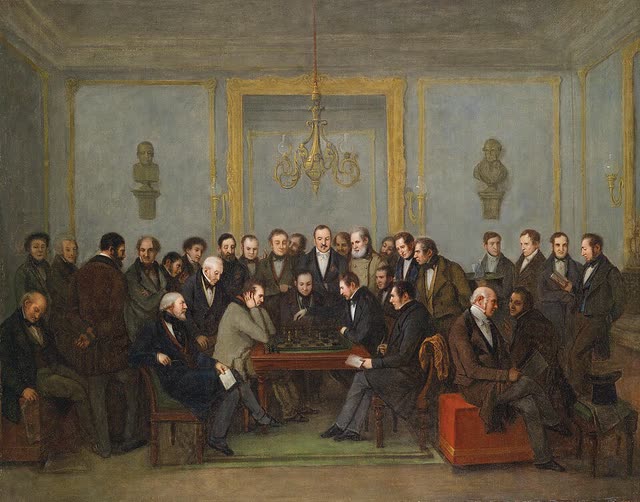
In the 1700s chess moved out of palaces and into coffeehouses, where anyone could sit down and play. The 1800s brought clubs, the first international tournament (London, 1851) and the first official world championship match (1886). The 1900s added FIDE, team Olympiads, ratings and the Soviet chess school, and since the 1990s the internet has made chess a game that millions of people play every day.
Coffeehouse chess in Paris and London
For two centuries the heart of French chess was the Café de la Régence, a coffeehouse near the Palais-Royal in Paris. Almost every great master of the 1700s and 1800s played there. London had its own chess coffeehouses, above all Simpson's Divan on the Strand.
The first star of the Régence was François-André Philidor (1726–1795), who was also a successful opera composer. He learned at the café from the best French player of the day, Legall de Kermeur, and soon passed him. In 1749 Philidor published L'Analyse des échecs, a book that stayed in print for more than a century. Its big idea is usually quoted in English as "the pawns are the soul of chess": where your pawns stand decides where your pieces belong. In London in 1783 he also amazed spectators by playing three blindfold games at once, without seeing any of the boards.
By the 1830s chess was becoming an international contest. In 1834 the Frenchman Louis-Charles Mahé de La Bourdonnais beat the Irishman Alexander McDonnell in a famous series of matches.
Staunton and the first international tournament
In December 1843 the Englishman Howard Staunton beat Pierre de Saint-Amant, the best French player, in a match at the Café de la Régence (the painting at the top of this page shows it). Staunton was then widely seen as the strongest player in the world. He wrote The Chess-Player's Handbook (1847), and in 1849 he promoted a new, easy-to-read design of chess pieces drawn by Nathaniel Cooke and made by Jaques of London. These "Staunton" pieces are still the shape used in tournaments today.
Staunton's biggest idea was a tournament for the best players of many countries. It was held in London in 1851, at the same time as the Great Exhibition. Sixteen players met in a knockout event, and Adolf Anderssen of Germany won it clearly. In London that same year Anderssen also played a friendly game against Lionel Kieseritzky that became known as the Immortal Game.
Morphy, the shooting star
In 1857 a 20-year-old from New Orleans, Paul Morphy, won the First American Chess Congress. The next year he sailed to Europe and beat almost everyone he played, Anderssen included. One of his best-known games, the Opera Game, was played in a theatre box in Paris in 1858. Then, after returning home in 1859, he gave up serious chess. His story is on our Paul Morphy page.
Clocks and notation
Early masters could think for as long as they liked. In the 1834 matches McDonnell sometimes spent up to an hour and a half on a single move. The first time limits, measured with sandglasses, appeared in 1861. Chess clocks, invented by Thomas Bright Wilson of Manchester, were first used at the London tournament of 1883. A chess clock has two faces: when you make your move you press your button, your clock stops and your opponent's clock starts. Much later, Bobby Fischer patented a digital clock that adds a few seconds after every move. This "increment" was first used in 1992 and is now standard in most top events.
Players also needed one shared way to write down moves. Philipp Stamma used an early form of algebraic notation (moves written as e4, Nf3 and so on) in 1737. German books made it standard in the 1800s, but English-language books used an older "descriptive" system until about the 1970s. Since 1981 FIDE has recognised only algebraic notation.
The first world champion, 1886
Before 1886 people argued about who was the best, but there was no official title. That year Wilhelm Steinitz and Johannes Zukertort played the first official world championship match, in New York, St Louis and New Orleans. The first player to win ten games would take the title. Steinitz won by 10 wins to 5, with 5 draws. Every champion since then is on our world chess champions page.
FIDE and the Olympiads
The International Chess Federation, known by its French initials FIDE, was founded in Paris on 20 July 1924, while the Olympic Games were being held in the city. In 1927 FIDE held the first official Chess Olympiad, a team competition between countries, in London, and the first Women's World Championship, won by Vera Menchik. In 1948 FIDE took charge of the world championship itself.
The Soviet school
After the 1917 revolution the Soviet state supported chess as a national pastime. Its players treated chess as a sport, with hard, organised training and study, rather than as an art or a hobby. After the Second World War this paid off: Mikhail Botvinnik won the world title in 1948, and Soviet players held it for the next 24 years. Soviet women's teams won every Women's Chess Olympiad they played from 1957 to 1986.
Fischer against Spassky, 1972
That long run was broken by one American. In 1972, in Reykjavík, Iceland, Bobby Fischer beat Boris Spassky 12½–8½. It was the middle of the Cold War, the match made headlines around the world, and Fischer became the first American-born world champion. He never defended the title, and Anatoly Karpov took it without a match in 1975.
Ratings: a number for your strength
Arpad Elo, a Hungarian-American physics professor and chess master, designed a rating system that the United States Chess Federation adopted in 1960. FIDE adopted it in 1970. The idea is simple: beat a stronger player and your rating goes up a lot; lose to a weaker one and it drops. Almost every chess website still uses ratings based on Elo's idea.
Women in chess
For a long time women were not even allowed to join most chess clubs. Vera Menchik, the first women's world champion, was also the first woman to play in top tournaments against the best men, from the late 1920s. Nona Gaprindashvili and Maia Chiburdanidze, both from Georgia, were the first women to earn the grandmaster title. Judit Polgár went further still: in 1996 she became the first woman in the overall world top ten, later reaching number 8, and in 2002 she beat the world number one, Garry Kasparov, in a rapid game. All the women's champions are on our women's world chess champions page.
The internet era
Live online chess began in 1992 with the Internet Chess Server, where you played by typing commands. Websites followed: Chess.com started in 2007 and Lichess in 2010. Free chess engines put grandmaster-strength analysis on every laptop, a story told in chess and computers.
Then came 2020. Stuck at home during the COVID-19 pandemic, many people started playing online, and streamers showed live games with chatty commentary. In October 2020 Netflix released The Queen's Gambit, a drama about a fictional chess prodigy. In the United States, sales of chess sets rose 87% in the three weeks after the show came out, and sales of chess books rose more than 600%, according to the market research firm NPD.
The champions keep getting younger. In December 2024 Gukesh Dommaraju of India beat Ding Liren in Singapore and, at 18, became the youngest undisputed world champion in history. As of November 2026 he still holds the title, and his title match against Javokhir Sindarov of Uzbekistan is due to begin in Geneva in late November 2026. Read more on our Gukesh Dommaraju page.
Sources
- History of chess (Wikipedia)
- Howard Staunton (Wikipedia)
- World Chess Championship 1886 (Wikipedia)
- Elo rating system (Wikipedia)
- Women in chess (Wikipedia)
- Chess set, book sales surge following premiere of The Queen's Gambit (Fox Business, 26 November 2020)
- Indian teen prodigy Gukesh becomes youngest world chess champ (Dawn, 13 December 2024)
- Geneva to host FIDE World Championship Match 2026 (FIDE, 28 July 2026)
Checked in November 2026.
Questions and answers
- When was the first chess tournament?
- The first international chess tournament was held in London in 1851. Howard Staunton organised it, and Adolf Anderssen of Germany won.
- Who was the first official world chess champion?
- Wilhelm Steinitz. He beat Johannes Zukertort in 1886, in a match played in New York, St Louis and New Orleans.
- When was FIDE founded?
- FIDE, the International Chess Federation, was founded in Paris on 20 July 1924.
- When were chess clocks first used?
- Sandglasses were used to time a match in 1861, and mechanical chess clocks were first used at the London tournament of 1883.
- Why did chess become so popular in 2020?
- During the COVID-19 pandemic many people played online at home, streamers brought chess to new fans, and the Netflix series The Queen's Gambit, released in October 2020, sparked a wave of interest.
Play free now — no sign-up needed