 ChessMess
The birth of modern chess: the new queen, Lucena, Ruy López and Greco
How chess became the modern game in Spain and Italy around 1475–1500: the new queen and bishop, the first printed chess books, Ruy López and Greco.
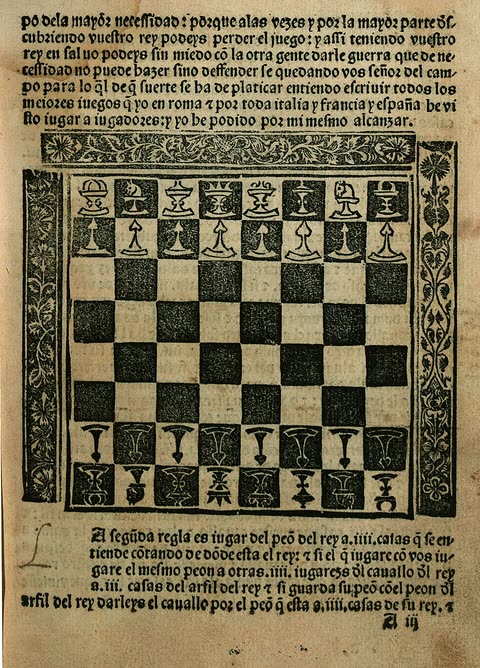
Modern chess was born in Spain and Italy at the end of the 1400s. Between about 1475 and 1500 the queen, until then one of the weakest pieces, became the strongest, and the bishop got its long diagonal move. Within a hundred years, printed books by Lucena, Damiano and Ruy López had carried the new, faster game across Europe, although smaller rules such as castling took much longer to settle.
Chess before the change
Chess came to Europe from India by way of Persia and the Arab world (the beginning of the story is in how chess was invented). For about 500 years Europeans played a slow game. The piece next to the king was a counsellor that moved just one square diagonally. The bishop hopped exactly two squares diagonally. Pawns moved one square at a time. The armies took many moves to meet, and a game could be won by slowly capturing everything except the enemy king.
The new queen and bishop
Then two pieces were transformed. The queen could now move any distance in a straight line or along a diagonal, like a rook and a bishop combined. The bishop could slide any distance along its diagonals. Most of the evidence points to Spain, and especially to the Kingdom of Valencia.
The new game had nicknames. Lucena called it the game "of the lady" (de la dama), to set it apart from the old game. In Italy it was called scacchi alla rabiosa, roughly "madwoman's chess", which is why you will often hear the name "mad queen chess": the queen suddenly raced from one side of the board to the other.
Why a queen? Nobody knows for sure. The historian Marilyn Yalom suggested that powerful real queens, above all Isabella I of Castile, may have inspired the change. That is an interesting idea, not a proven fact.
The effect was huge. A queen could now attack from far away, so games became faster and sharper. Checkmate came sooner, and a pawn that reached the far side and became a queen was suddenly a big prize. Players also began to study the opening (the first moves of the game), because a mistake there could now lose quickly.
Scachs d'amor: the first game with the new queen
The oldest known game played with the new queen and bishop comes from a love poem. Scachs d'amor ("Chess of Love") was written in Catalan in Valencia. It is usually dated to about 1475, although the exact year is still debated. Three Valencian writers made it together: Francesc de Castellví and Narcís Vinyoles play the game, standing for Mars and Venus, and Bernat Fenollar acts as the judge and explains the rules. The manuscript was found in Barcelona in 1905. The original has since been lost, but photographs of it survive.
The game starts 1.e4 d5, the opening we now call the Scandinavian Defence, and ends when White's queen gives checkmate on move 21.
Printed books spread the new rules
The printing press was still new, and printed chess books helped the new game spread fast. The oldest surviving printed chess book, Luis Ramírez de Lucena's Repetición de amores y arte de ajedrez, was printed in Salamanca around 1497 (the picture at the top shows one of its pages). Some of its 150 positions use the old rules and some use the new ones, a snapshot of a game in the middle of changing.
In 1512 a Portuguese pharmacist, Pedro Damiano, published a chess book in Rome. It went through eight editions in the 1500s, which shows how hungry readers were. Damiano gave the rules, short opening lines and puzzles. His book is also the oldest to say clearly that the corner square on each player's right must be a light square, exactly the rule you follow when you set up a board today. And it contains advice that coaches still repeat: when you see a good move, look for a better one.
Ruy López and the Spanish Game
Ruy López de Segura was a Spanish priest and the strongest player in Spain for about twenty years. His Libro de la invención liberal y arte del juego del axedrez (1561) is one of the first big books on modern chess. He studied openings much more deeply than earlier writers. He also took the word gambito from Italian players: a gambit is an opening where you give up a pawn, or more, to get your pieces out faster or to attack.
After 1.e4 e5 2.Nf3 Nc6, López preferred 3.Bb5 to 3.Bc4. That opening now carries his name: the Ruy Lopez, or Spanish Game, is still played by the best players in the world. Funnily enough, López was not the first to show it. An older Latin manuscript kept in Göttingen, Germany, already includes it.
In the mid-1570s two Italian stars, Leonardo di Bona and Paolo Boi, visited the court of King Philip II in Madrid and beat López and another Spanish master, Alfonso Cerón. Some writers call these meetings the first international chess tournament.
Greco, the first professional
Gioachino Greco was born around 1600 in Calabria, in the south of Italy. He was probably the strongest player of his time, beating the best players of Rome, Paris, London and Madrid, and he made his living from chess, playing rich patrons and writing handwritten books of games for them from 1620 onwards. Earlier writers mostly showed single positions; Greco recorded whole games. His collections were printed after his death, in English in 1656 and in French in 1669, and copied for centuries.
Greco's opponents are never named (they appear as "NN", meaning name unknown), and many of the games may have been made up to show traps. They are still wonderful lessons in fast attacks. In this game from his 1620 collection, Greco has Black. After 1.e4 e5 2.Nf3 Nc6 3.Bc4 Bc5, the Italian Game, White plays carelessly and Black's queen and knight crash in. On move 12 Black gives the queen away with 12...Qg1+! The white king cannot take it, because the bishop on c5 guards g1, so a white piece must take the queen. That piece now blocks the king's last free square, and the knight jumps to f2: 13...Nf2 is checkmate.
This is a smothered mate: a knight checkmates a king that is trapped by its own pieces. You can practise the pattern in our smothered mate puzzles.
How long the details took
The new queen and bishop spread quickly, but other rules took centuries to agree on:
- Castling (the move that tucks the king away behind a rook) became a single move in France around 1620 and in England around 1640. In Italy, different castling rules lasted until the late 1800s.
- En passant, a special pawn capture, was not used in Italy until 1880.
- Stalemate (the player to move has no legal move but is not in check) was a win, half a win or even a loss in different places before it became a draw everywhere in the 1800s.
- Promotion was limited in parts of Europe in the 1700s: a pawn could only become a piece you had already lost, so you could never have two queens.
The full story is on our page about how the rules of chess changed. From Greco the road leads to Philidor and the chess coffeehouses of Paris and London, told in chess from coffeehouses to world championships.
Sources
- Scachs d'amor (Wikipedia), including the full game score
- Sergio Ernesto Negri, "Scachs d'amor: The poem that first portrayed the modern rules of chess" (ChessBase)
- Valencia and the origin of modern chess (Chess.com)
- Queen (chess): history of the piece (Wikipedia)
- Pedro Damiano (Wikipedia)
- Ruy López de Segura (Wikipedia)
- Gioachino Greco (Wikipedia)
- NN vs Gioachino Greco, 1620: game score (chessgames.com)
Checked in November 2026.
Questions and answers
- When did modern chess start?
- Modern chess began in Spain and Italy in the late 1400s, when the queen and the bishop gained their long-range moves, between about 1475 and 1500.
- Why is it called mad queen chess?
- Italians called the new game scacchi alla rabiosa, roughly 'madwoman's chess', because the queen suddenly raced across the board instead of moving one square at a time.
- What is the oldest printed chess book?
- The oldest surviving one is Luis Ramírez de Lucena's Repetición de amores y arte de ajedrez, printed in Salamanca, Spain, around 1497.
- Why is the Ruy Lopez opening named after Ruy López?
- Ruy López de Segura, a Spanish priest and the best player in Spain, recommended 3.Bb5 after 1.e4 e5 2.Nf3 Nc6 in his book of 1561, so the opening took his name, even though an older manuscript already shows it.
- Who was Gioachino Greco?
- An Italian player born around 1600 who was probably the strongest of his time and lived from chess. His collections of complete games, full of famous traps, were printed and copied for centuries.
Play free now — no sign-up needed