 ChessMess
Who invented chess? How chaturanga began in India
Chess began in India as chaturanga around the 6th century CE. What historians know, what they still argue about, and which famous stories are only legends.
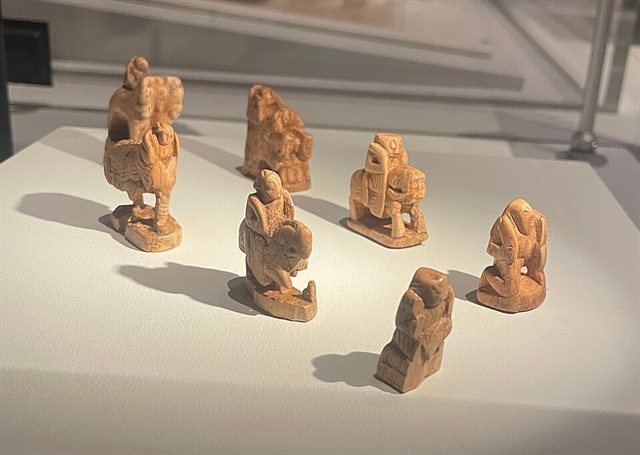
Nobody knows the name of the person who invented chess. The earliest clear evidence points to India, where a war game called chaturanga was being played by around the 6th century CE, near the end of the Gupta period. From India the game travelled to Persia, then across the Islamic world and into Europe, slowly changing into the chess we play today.
What "chaturanga" means
Chaturanga is a Sanskrit word. It means "having four limbs" or "four parts", and in old Indian poetry it often simply means "army". An Indian army of that time had four divisions: elephants, chariots, cavalry (soldiers on horses) and infantry (soldiers on foot). The great epic, the Mahabharata, uses the word for a battle formation.
The game was a small copy of that army. Each side had a king, a minister and the four divisions. They are still on your board today: the foot soldiers became pawns, the horses became knights, the chariots became rooks, and the elephants became bishops.
The board and the pieces
Chaturanga was played on the ashtapada, a board of 8 by 8 squares. Unlike a modern chessboard, all the squares were the same colour. The board may be older than chess: it was possibly used first for a race game played with dice. Some old Indian boards have crosses marked on certain squares, and nobody is sure what they meant.
No early rule book survives, so historians rebuild the rules from later Persian and Arabic books. As far as we can tell, the pieces moved like this:
| Piece | Meaning | How it moved | Today |
|---|---|---|---|
| Raja | King | One square in any direction | King |
| Mantri (or senapati) | Minister (or general) | One square diagonally | Queen |
| Ratha | Chariot | Any distance in a straight line | Rook |
| Gaja | Elephant | Not certain; most likely a jump of exactly two squares diagonally | Bishop |
| Ashva | Horse | An L-shaped jump | Knight |
| Padati | Foot soldier | One square forward, capturing diagonally, with no two-square first move | Pawn |
The minister was weak, nothing like the modern queen. A pawn that reached the far side became a minister. A player won by checkmating the enemy king, or by capturing every enemy piece except the king. The knight is the one piece that still moves exactly as it did about 1,500 years ago. You can practise its jump in the knight lesson.
The earliest written evidence
India. Around 625 CE the court poet Banabhatta wrote the Harshacharita, a life of King Harsha, who ruled much of northern India. In a play on words he praises the king's peaceful rule: in Harsha's kingdom, he says, the only place where anyone drew up a chaturanga (a four-part army) was on an ashtapada board. This is the oldest known written use of the game's name.
Persia. Three books in Middle Persian, the language of the Sasanian empire, mention the game, which the Persians called chatrang. One of them, usually called the Book of Chess (Chatrang-namag), tells how an Indian king sent the game to the Persian king Khosrow I, who ruled from 531 to 579. Persian writers clearly believed that chess came from India.
The Arab world. Later Arabic writers agreed. Al-Adli, who wrote one of the first chess books around 840, said the game came from India. So did the 10th-century historian al-Masudi.
The great chess historian H. J. R. Murray, writing in 1913, concluded that chess certainly existed in the 7th century and had already reached Persia by then. He dismissed claims of a far older chess, "five thousand years ago" and the like, as guesswork.
The oldest chess pieces
The oldest objects that are surely chess pieces are seven small ivory figures found at Afrasiab, the old site of Samarkand in today's Uzbekistan (pictured above). They were made in the 700s. Almost all of the oldest pieces found so far come from along the Silk Road, the old trade routes that joined India, Central Asia, Persia and China.
Older finds are sometimes called chess pieces, but they are doubtful. Game pieces thousands of years old have been found in India, for example at Lothal, a city of the Indus Valley civilisation, but most historians think they belonged to other board games. Two tiny figures, an elephant and a bull, from Dalverzin Tepe in Uzbekistan date from the 1st or 2nd century CE. Some have suggested they are chess pieces, which would make chess about 400 years older than we think. So far that is only an idea.
Did chess begin somewhere else?
By the 20th century most historians agreed that chess began in north-west India, by the early 7th century at the latest. Some have questioned this, and two other ideas come up often.
China. Xiangqi, or Chinese chess, is a close cousin of our game. A few writers argue that chess began in China and moved west. The translator David H. Li suggested that a Chinese general created an early form of xiangqi around 204 BCE. The German chess historian Peter Banaschak answered that this idea rests on almost no evidence: the first real description of xiangqi is in a Chinese book from about 800 CE. On the other side, the historians Jean-Louis Cazaux and Rick Knowlton argue that the features of xiangqi make a path from China to India easier to explain than the reverse. Still, most historians think xiangqi grew out of chaturanga, not the other way round.
Central Asia. Because the oldest pieces come from the Silk Road, some historians think the game took its final shape in the lands between India, Persia and China, as traders and travellers carried it along. The oldest writings, though, still point first to India and then to Persia.
In short: the oldest words point to India, the oldest pieces point to Central Asia, and the game clearly moved quickly along the trade routes. Chess was probably not "invented" in one day by one person. It grew out of older games over many years.
The legends
Many stories name an inventor of chess. They are legends, not history, but they are fun to know.
The wheat and the chessboard. A famous legend says that a wise Brahmin named Sissa invented chess for an Indian king. When the king offered a reward, Sissa asked for one grain of wheat on the first square, two on the second, four on the third, and so on, doubling on every square. The king laughed at such a small request, until his treasurers did the sums. The total is 18,446,744,073,709,551,615 grains, far more grain than any king owned. The story was first written down by Ibn Khallikan in 1256. In some versions Sissa is rewarded; in others he loses his head.
Talhand and Gav. Ferdowsi's Persian epic, the Shahnameh (Book of Kings), finished around 1010, tells of two half-brothers, Gav and Talhand, who fought for the throne of India. Talhand died on his elephant without a single wound. To show their grieving mother what had happened, the wise men of the court made a board and pieces and played out the battle. In the story, that was the first game of chess. The poem describes Talhand's end with the words "shah mat", which later became "checkmate".
How chess left India
From India the game reached Persia by the 6th century and became chatrang. After the Arab conquest of Persia in the 7th century it became shatranj and spread across the Islamic world: read Chess in Persia and the Islamic world. Travelling east, the same family of games produced xiangqi in China, shogi in Japan and makruk in Thailand. In India itself chess never went away, and today India is a chess superpower: see Chess in India.
The long journey also explains why our pieces have such strange names. A minister became a queen and an elephant became a bishop. The full story is in Chess pieces: names and history, and the later rule changes are in How the rules of chess changed.
Sources
- H. J. R. Murray, A History of Chess (1913), on the Internet Archive
- Chaturanga (Wikipedia)
- Chess: the history section (Wikipedia)
- Origins of chess (Wikipedia)
- Chess in early literature (Wikipedia)
- Wheat and chessboard problem (Wikipedia)
- Dalverzin Tepe (Wikipedia)
Checked in November 2026.
Questions and answers
- Who invented chess?
- Nobody knows. Chess grew out of chaturanga, a war game played in India by around the 6th century CE. Stories about a wise man called Sissa who invented it are legends, not history.
- When was chess invented?
- The earliest clear evidence comes from India and Persia in the 6th and early 7th centuries CE. The name chaturanga first appears in writing around 625 CE, and the oldest surviving chess pieces were made in the 700s.
- Did chess come from India or China?
- Most historians say India. The oldest writings about the game are Indian and Persian, and Persian and Arab authors said it came from India. A minority view says chess began in China, but the first reliable description of Chinese chess (xiangqi) is from about 800 CE.
- What does chaturanga mean?
- It is a Sanskrit word meaning 'four parts' or 'four limbs', and it was used for an army with four divisions: elephants, chariots, cavalry and foot soldiers. Those became the bishops, rooks, knights and pawns of modern chess.
- Is the wheat and chessboard story true?
- No, it is a legend. It was first written down by Ibn Khallikan in 1256. Doubling one grain on each of the 64 squares gives 18,446,744,073,709,551,615 grains, far more than any kingdom had.
Play free now — no sign-up needed