 ChessMess
Chess pieces: their names in many languages and their history
Where the chess pieces got their names, from Sanskrit and Persian to Hindi, Urdu and European languages, how their moves changed, and the 1849 Staunton set.
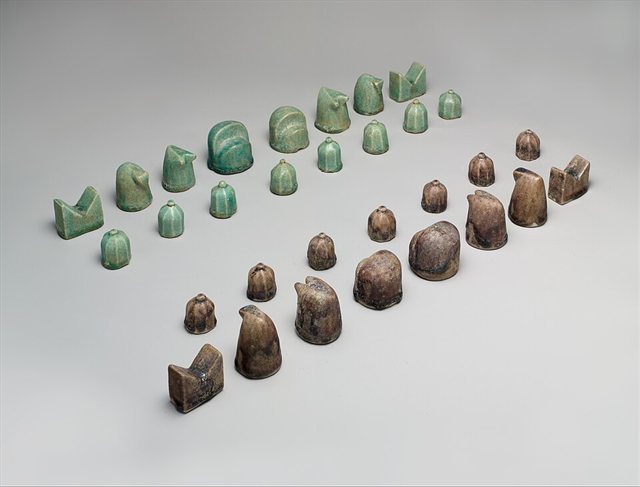
Every chess piece carries a long story in its name. The rook was once a chariot, the bishop was an elephant, and the queen was a male adviser who could only step one square at a time. As chess travelled from India to Persia, the Arab world and Europe, each culture kept some names, translated others and invented new ones. This page explains where each name comes from, what the pieces are called in Hindi, Urdu and European languages, how their moves changed, and why almost every chess set today looks the same.
The first names: India and Persia
Most historians think chess began in India by the 6th or 7th century CE, as chaturanga. The Sanskrit word means "four parts", the four branches of an old Indian army: elephants, horses, chariots and foot soldiers. (Exactly where and when chess began is still debated; see how chess was invented.) The game moved to Persia, where it became chatrang and later shatranj, and after the Arab conquest of Persia it spread across the Islamic world.
| Today | Sanskrit (chaturanga) | Persian (shatranj) | Arabic (shatranj) | What the old name means |
|---|---|---|---|---|
| King | raja | shah | shah | king |
| Queen | mantri (or senapati) | farzin (ferz) | firzan, firz or wazir | adviser, minister (senapati: general) |
| Rook | ratha | rukh | rukh | chariot |
| Bishop | gaja (or hastin) | pil | al-fil | elephant |
| Knight | ashva | asb | faras | horse |
| Pawn | padati (or bhata) | piyadeh | baidaq | foot soldier |
So the old game was a small army: a king with his adviser beside him, elephants, horses, chariots and a line of foot soldiers. The Persian word shah still hides inside our chess words. "Checkmate" comes from shah mat, usually explained as "the king is dead" or "the king is helpless". Read more in chess in India and chess in Persia and the Islamic world.
How Europe renamed the pieces
Chess reached Europe through Spain and Sicily by the 10th century. Europeans had no idea what a firzan or an al-fil was, so they changed many names to fit their own world of kings, queens, knights and bishops.
- Rook. Europeans kept the sound of the Persian rukh (chariot), which is where English "rook" comes from. But carvers made the piece look like a castle tower, so French calls it tour, German Turm and Spanish torre, all meaning "tower". Russian calls it ladya, a boat.
- Bishop. The Arabic al-fil (the elephant) lives on in Spanish alfil and Italian alfiere, and Russian still calls the piece slon, an elephant. Elsewhere the name changed completely: French fou means jester and German Läufer means runner. English chose "bishop" because the split top of the piece looked like a bishop's tall hat, the mitre.
- Queen. In shatranj this was the king's adviser, Persian farzin. In Europe the adviser became a lady: a Latin poem from about 997, the Einsiedeln Poem, already calls the piece regina, queen. French and German say dame and Dame, Spanish dama. Russian still uses the old Persian name, ferz.
- Knight. The horse stayed a horse almost everywhere: Spanish caballo, Italian cavallo, Russian kon. English "knight" and French cavalier name the rider instead, and German Springer means jumper.
- Pawn. The foot soldier stayed a foot soldier. English "pawn", French pion and Italian pedone all go back to the Latin for a soldier on foot. German Bauer means farmer.
- King. The only piece whose meaning never changed: raja, shah, rex, roi, König, korol.
| English | French | German | Spanish | Italian | Russian |
|---|---|---|---|---|---|
| King | roi | König | rey | re | korol |
| Queen | dame | Dame | dama | donna | ferz |
| Rook | tour | Turm | torre | torre | ladya |
| Bishop | fou | Läufer | alfil | alfiere | slon |
| Knight | cavalier | Springer | caballo | cavallo | kon |
| Pawn | pion | Bauer | peón | pedone | peshka |
The pieces in Hindi and Urdu
In India and Pakistan the game is still called shatranj (Hindi शतरंज, Urdu شطرنج), and many piece names are Persian words mixed with local ones. Names vary from region to region and even from family to family, but these are the most common:
| Piece | Hindi | Urdu | Meaning |
|---|---|---|---|
| King | raja (राजा), also badshah | badshah (بادشاہ) | king, emperor |
| Queen | wazir (वज़ीर), also rani or mantri | wazir (وزیر) | minister; rani means queen |
| Rook | haathi (हाथी), also kishti | rukh (رخ) | elephant; kishti means boat |
| Bishop | oont (ऊँट) | fil (فیل) or feela (فیلہ), also haathi | camel in Hindi, elephant in Urdu |
| Knight | ghoda (घोड़ा) | ghora (گھوڑا) | horse |
| Pawn | pyada (प्यादा), also sipahi | piyada (پیادہ), also sipahi | foot soldier |
Watch out for the elephant. In Hindi, haathi (elephant) usually means the rook, and the bishop is oont, the camel. Urdu keeps the older Persian pattern, where the fil or elephant, also called haathi, is the bishop, the piece that stands beside the king and the wazir. So two players can both say "haathi" and point at different pieces. If you learn from a book or an app, look at its pictures first.
How the moves changed
The rook (straight lines, any distance) and the knight (the L-shaped jump) have moved the same way for well over a thousand years, and the king has always stepped one square in any direction. The other pieces changed a lot:
| Piece | Old move in shatranj | Modern move | When it changed |
|---|---|---|---|
| Queen | one square diagonally | any distance in a straight line or diagonal | late 1400s, Spain |
| Bishop | a jump of exactly two squares diagonally | any distance diagonally | late 1400s |
| Pawn | one square forward; promoted only to the weak adviser | two squares on its first move, en passant, promotion to any piece | step by step, 1200s to 1800s |
| King | one square in any direction | the same, plus castling | castling added between 1200 and 1600 |
The big change came at the end of the 15th century. The earliest known text using the powerful new queen is a poem from Valencia in Spain, Scachs d'amor, from about 1475, and Luis Ramírez de Lucena described the new rules in a printed book around 1497. The new game was faster and fiercer. Fans called it "the queen's chess", while critics called it "madwoman's chess". Within a few decades it had replaced the old game across Europe. The full story is in how the rules of chess changed.
That is why the queen, once one of the weakest pieces, is now worth about nine pawns: see chess piece values.
The Staunton set: why almost every chess set looks the same
Until the middle of the 1800s, chess sets looked very different from country to country. English players used tall "Barleycorn" and "St George" pieces, the French had their "Régence" style, and central Europe had its own shapes. As players from different countries met more often, they needed one design that everyone could read at a glance.
On 1 March 1849, Nathaniel Cooke, editor of the Illustrated London News, registered a new design for chessmen in London. The firm of John Jaques made the pieces, and they went on sale that September. Cooke asked Howard Staunton, the most famous English player of the day, to promote them in his chess column, and the design has carried Staunton's name ever since. Historians still argue about how much of it came from Cooke and how much from Jaques.
Why did it win?
- Every piece is easy to recognise: a cross on the king, a crown on the queen, a mitre with a slit on the bishop, a carved horse's head, a castle tower and a small round pawn.
- It is practical: wide, weighted bases keep the pieces steady, and the simple turned shapes were cheap to make in large numbers.
- It had a star behind it: Staunton's name and a popular newspaper sold it to the public.
Today FIDE, the international chess federation, says tournament pieces should be in the Staunton style, with the king about 9.5 cm tall. Its current equipment rules took effect on 1 March 2026. Most chess apps and websites draw their pieces from the same shapes.
Notation letters in different languages
When you write down a chess game, each piece gets a letter. English uses K (king), Q (queen), R (rook), B (bishop) and N (knight). It is N because K is already taken by the king. Pawns get no letter at all. Other languages use the first letter of their own words:
| Language | King | Queen | Rook | Bishop | Knight |
|---|---|---|---|---|---|
| English | K | Q | R | B | N |
| German | K | D | T | L | S |
| French | R | D | T | F | C |
| Spanish | R | D | T | A | C |
| Russian | Кр | Ф | Л | С | К |
So the English move Nf3 is Sf3 in German and Cf3 in French and Spanish. To avoid this confusion, many chess books print small pictures of the pieces instead of letters. You can learn to read moves in how to play chess.
The chess symbols in Unicode
Unicode, the worldwide standard for text characters, has all twelve chess pieces, so you can type them in messages and documents:
| Piece | White | Black | Unicode |
|---|---|---|---|
| King | ♔ | ♚ | U+2654, U+265A |
| Queen | ♕ | ♛ | U+2655, U+265B |
| Rook | ♖ | ♜ | U+2656, U+265C |
| Bishop | ♗ | ♝ | U+2657, U+265D |
| Knight | ♘ | ♞ | U+2658, U+265E |
| Pawn | ♙ | ♟ | U+2659, U+265F |
Sources
- Chaturanga and Shatranj, Wikipedia (Sanskrit, Persian and Arabic names and moves; both draw on H. J. R. Murray's A History of Chess)
- Chess piece, Wikipedia: names and notation letters in other languages
- Queen (chess), Wikipedia: from ferz to queen, the Einsiedeln Poem and Scachs d'amor
- शतरंज, Hindi Wikipedia: Hindi piece names
- شطرنج, Urdu Wikipedia, and Rekhta Dictionary: fiil: Urdu piece names
- Staunton chess set, Wikipedia
- FIDE Handbook: chess equipment rules, from 1 March 2026
Checked in November 2026.
Questions and answers
- Why is the rook called a rook?
- The name comes from the Persian word rukh, meaning chariot. Europeans kept the sound of the word but carved the piece as a castle tower, which is why many people also call it a castle.
- What are the chess pieces called in Hindi?
- The most common Hindi names are raja (king), wazir or rani (queen), haathi (rook), oont (bishop), ghoda (knight) and pyada (pawn). Names vary by region, and some people say badshah for the king or mantri for the queen.
- What are the chess pieces called in Urdu?
- Common Urdu names are badshah (king), wazir (queen), rukh (rook), fil or feela (bishop, meaning elephant, also called haathi), ghora (knight) and piyada (pawn).
- Why was the queen once a weak piece?
- In the old Persian and Arab game the piece was the king's adviser, the ferz, and it could move only one square diagonally. It became the powerful modern queen in Spain at the end of the 1400s.
- What is a Staunton chess set?
- It is the standard design of chess pieces, registered in London in 1849 by Nathaniel Cooke, made by John Jaques and promoted by the player Howard Staunton. FIDE asks for Staunton-style pieces in tournaments.
Play free now — no sign-up needed