 ChessMess
The most famous chess games in history, explained simply
Ten of the most famous chess games ever played, from the Immortal Game of 1851 to Gukesh's world title win in 2024, with full moves, diagrams and why each matters.
The most famous chess game in history is probably the Immortal Game, played in London in 1851, in which Adolf Anderssen gave away a bishop, both rooks and his queen and still won. Close behind come Paul Morphy's Opera Game (1858), Bobby Fischer's "Game of the Century" (1956), Deep Blue's win over Garry Kasparov (1997) and Kasparov's own masterpiece against Veselin Topalov (1999). This page tells the story of ten famous games: who played, when, why each one matters, the full moves and a diagram of the key moment.
The ten games at a glance
| Year | Game | Why it is famous |
|---|---|---|
| 1851 | Anderssen vs Kieseritzky, London | The Immortal Game: a queen and two rooks given away for mate |
| 1852 | Anderssen vs Dufresne, Berlin | The Evergreen Game: a quiet rook move, then a mating attack |
| 1858 | Morphy vs the Duke and the Count, Paris | The Opera Game: the best lesson in fast development |
| 1889 | Lasker vs Bauer, Amsterdam | The famous double bishop sacrifice |
| 1910 | Réti vs Tartakower, Vienna | A queen sacrifice and a double check, mate in 11 moves |
| 1956 | Byrne vs Fischer, New York | The Game of the Century, won by a 13-year-old |
| 1972 | Fischer vs Spassky, Reykjavík, game 6 | Fischer's near-perfect game in the Match of the Century |
| 1997 | Deep Blue vs Kasparov, New York, game 6 | A computer beats the world champion in a match |
| 1999 | Kasparov vs Topalov, Wijk aan Zee | Often called the greatest game ever played |
| 2024 | Ding Liren vs Gukesh, Singapore, game 14 | An 18-year-old becomes world champion |
How to read the moves
The moves on this page are written in standard algebraic notation. Every square has a name, such as e4 (see the board lesson). K is the king, Q the queen, R a rook, B a bishop and N a knight; a move with no capital letter is a pawn move. An "x" means a capture, "+" means check, "#" means checkmate, and O-O is castling (O-O-O on the queenside). Writers add "!" to a strong move, "!!" to a brilliant one and "?" to a mistake.
1. The Immortal Game: Anderssen vs Kieseritzky, London 1851
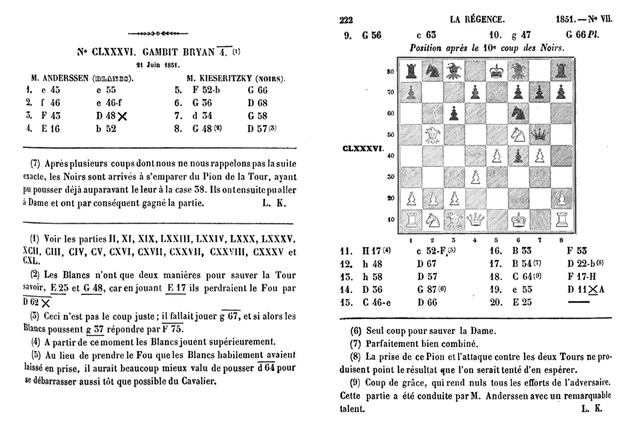
In the summer of 1851 London held the first big international chess tournament, and Adolf Anderssen, a German mathematics teacher, went on to win it. During the event he played a friendly game against Lionel Kieseritzky, a professional who gave lessons at the Café de la Régence in Paris. Kieseritzky's own report in the Paris magazine La Régence (the picture at the top of this page) dates it 21 June 1851.
The game began with the King's Gambit, an opening where White gives up a pawn on move 2 to open lines. Anderssen then gave away a bishop, offered both rooks and finally gave up his queen. With just two knights and a bishop left, he trapped the black king. The Austrian master Ernst Falkbeer named it "the Immortal Game" in 1855.
There is one surprise. Kieseritzky wrote that he resigned after White's 20th move, so the famous finish with the queen sacrifice may only have been shown after the game. It is almost always printed as part of it.
Full game: 1.e4 e5 2.f4 exf4 3.Bc4 Qh4+ 4.Kf1 b5 5.Bxb5 Nf6 6.Nf3 Qh6 7.d3 Nh5 8.Nh4 Qg5 9.Nf5 c6 10.g4 Nf6 11.Rg1 cxb5 12.h4 Qg6 13.h5 Qg5 14.Qf3 Ng8 15.Bxf4 Qf6 16.Nc3 Bc5 17.Nd5 Qxb2 18.Bd6 Bxg1 19.e5 Qxa1+ 20.Ke2 Na6 21.Nxg7+ Kd8 22.Qf6+ Nxf6 23.Be7# 1-0
Go through it move by move in the Immortal Game lesson.
2. The Evergreen Game: Anderssen vs Dufresne, Berlin 1852
A year later Anderssen played another masterpiece, this time against Jean Dufresne, a popular chess author. It was probably a friendly game in Berlin; the first report gave no details. The opening was the Evans Gambit, in which White again gives a pawn for fast development.
The famous moment is 19.Rad1, a calm rook move in the middle of a wild position. It set a deep trap. Dufresne grabbed the knight on f3 with his queen, and Anderssen replied with a rook sacrifice, a queen sacrifice and mate by two bishops. After Anderssen died in 1879, Wilhelm Steinitz, the first official world champion, praised 19.Rad1 as an "evergreen" in Anderssen's crown, and the name stuck.
Full game: 1.e4 e5 2.Nf3 Nc6 3.Bc4 Bc5 4.b4 Bxb4 5.c3 Ba5 6.d4 exd4 7.O-O d3 8.Qb3 Qf6 9.e5 Qg6 10.Re1 Nge7 11.Ba3 b5 12.Qxb5 Rb8 13.Qa4 Bb6 14.Nbd2 Bb7 15.Ne4 Qf5 16.Bxd3 Qh5 17.Nf6+ gxf6 18.exf6 Rg8 19.Rad1 Qxf3 20.Rxe7+ Nxe7 21.Qxd7+ Kxd7 22.Bf5+ Ke8 23.Bd7+ Kf8 24.Bxe7# 1-0
See every idea explained in the Evergreen Game lesson.
3. The Opera Game: Morphy vs the Duke of Brunswick and Count Isouard, Paris 1858
In 1858 Paul Morphy from New Orleans was widely seen as the strongest player in the world. In Paris that autumn he played in the Duke of Brunswick's private box at the Italian opera house, against the Duke and Count Isouard, who chose Black's moves together. Old accounts disagree about which opera was on stage that night.
Morphy shows exactly how to play an opening. He brings out a new piece almost every move, castles, and opens lines towards the enemy king, while his opponents waste time. He finishes with a queen sacrifice and mate on move 17. Teachers still use this game to show why fast development matters. Read more about Paul Morphy.
Full game: 1.e4 e5 2.Nf3 d6 3.d4 Bg4 4.dxe5 Bxf3 5.Qxf3 dxe5 6.Bc4 Nf6 7.Qb3 Qe7 8.Nc3 c6 9.Bg5 b5 10.Nxb5 cxb5 11.Bxb5+ Nbd7 12.O-O-O Rd8 13.Rxd7 Rxd7 14.Rd1 Qe6 15.Bxd7+ Nxd7 16.Qb8+ Nxb8 17.Rd8# 1-0
Practise it in the Opera Game lesson.
4. Lasker vs Bauer, Amsterdam 1889
Five years before he became world champion, the young Emanuel Lasker played Johann Hermann Bauer in the first round of a tournament in Amsterdam. After Bauer's careless 13...a6, Lasker sacrificed both of his bishops, on h7 and on g7, to rip away the pawns that protected the black king. A similar idea had been tried once before, but it was Lasker's game that made it famous.
Then Lasker's rook swung across to the h-file, Black had to give up his queen to stop mate, and a queen fork (one piece attacking two at once) on move 22 won one of Black's bishops. That left Lasker with a winning material advantage. The double bishop sacrifice has been repeated in many later games, including Polgár vs Karpov in 2003, and it is still taught as a way of attacking the castled king.
Full game: 1.f4 d5 2.e3 Nf6 3.b3 e6 4.Bb2 Be7 5.Bd3 b6 6.Nc3 Bb7 7.Nf3 Nbd7 8.O-O O-O 9.Ne2 c5 10.Ng3 Qc7 11.Ne5 Nxe5 12.Bxe5 Qc6 13.Qe2 a6 14.Nh5 Nxh5 15.Bxh7+ Kxh7 16.Qxh5+ Kg8 17.Bxg7 Kxg7 18.Qg4+ Kh7 19.Rf3 e5 20.Rh3+ Qh6 21.Rxh6+ Kxh6 22.Qd7 Bf6 23.Qxb7 Kg7 24.Rf1 Rab8 25.Qd7 Rfd8 26.Qg4+ Kf8 27.fxe5 Bg7 28.e6 Rb7 29.Qg6 f6 30.Rxf6+ Bxf6 31.Qxf6+ Ke8 32.Qh8+ Ke7 33.Qg7+ Kxe6 34.Qxb7 Rd6 35.Qxa6 d4 36.exd4 cxd4 37.h4 d3 38.Qxd3 1-0
5. Réti vs Tartakower, Vienna 1910
This is one of the most famous short games ever played. Richard Réti and Savielly Tartakower both became leading masters and well-known chess writers. Tartakower later called it a casual game, but the first report, in a Vienna newspaper on 1 April 1910, says they played it seriously, with clocks, for a small stake.
Tartakower left his king in the middle of the board and greedily took a knight with 8...Nxe4. Réti had just castled on the queenside, so his rook stood on the open d-file. Now he shocked his opponent with 9.Qd8+!!, giving up his queen. After 9...Kxd8, 10.Bg5+ is a double check: the bishop and the rook give check at the same time, so the king must move, and every square is a trap. After 10...Kc7, 11.Bd8 is mate. The first reports end with Black resigning after 10.Bg5+; the mate is how the game is usually shown.
Full game: 1.e4 c6 2.d4 d5 3.Nc3 dxe4 4.Nxe4 Nf6 5.Qd3 e5 6.dxe5 Qa5+ 7.Bd2 Qxe5 8.O-O-O Nxe4 9.Qd8+ Kxd8 10.Bg5+ Kc7 11.Bd8# 1-0
The opening is the Caro-Kann Defence. Play the game yourself in the Réti vs Tartakower lesson.
6. The Game of the Century: Byrne vs Fischer, New York 1956
On 17 October 1956, at the Marshall Chess Club in New York, 13-year-old Bobby Fischer played Black against Donald Byrne, one of the best American masters. On move 11 Fischer offered a knight, and on move 17 he left his queen to be taken with 17...Be6!!. In return he won a rook, two bishops and a pawn, and his pieces then chased the white king into a mating net. The magazine Chess Review called it "The Game of the Century".
Full game: 1.Nf3 Nf6 2.c4 g6 3.Nc3 Bg7 4.d4 O-O 5.Bf4 d5 6.Qb3 dxc4 7.Qxc4 c6 8.e4 Nbd7 9.Rd1 Nb6 10.Qc5 Bg4 11.Bg5 Na4 12.Qa3 Nxc3 13.bxc3 Nxe4 14.Bxe7 Qb6 15.Bc4 Nxc3 16.Bc5 Rfe8+ 17.Kf1 Be6 18.Bxb6 Bxc4+ 19.Kg1 Ne2+ 20.Kf1 Nxd4+ 21.Kg1 Ne2+ 22.Kf1 Nc3+ 23.Kg1 axb6 24.Qb4 Ra4 25.Qxb6 Nxd1 26.h3 Rxa2 27.Kh2 Nxf2 28.Re1 Rxe1 29.Qd8+ Bf8 30.Nxe1 Bd5 31.Nf3 Ne4 32.Qb8 b5 33.h4 h5 34.Ne5 Kg7 35.Kg1 Bc5+ 36.Kf1 Ng3+ 37.Ke1 Bb4+ 38.Kd1 Bb3+ 39.Kc1 Ne2+ 40.Kb1 Nc3+ 41.Kc1 Rc2# 0-1
The whole story, with every key move explained, is on the page about the Game of the Century.
7. Fischer vs Spassky, game 6, Reykjavík 1972
In 1972 the American challenger Bobby Fischer played world champion Boris Spassky of the Soviet Union in Reykjavík, Iceland. The press called it the Match of the Century. Fischer almost always opened with 1.e4, but in game 6, on 23 July, he played 1.c4, and the game turned into the Queen's Gambit Declined. Many people had never seen Fischer play that opening as White.
Spassky chose a defence he trusted and had never lost with. But after 20.e4! his centre pawns were stuck, and Fischer's bishop and rooks took over the board. Fischer built up slowly, pushed his e-pawn to e6 and broke through on the f-file. When the game ended, Spassky joined the audience in applauding his opponent. The win put Fischer ahead in the match for the first time, and he went on to win it 12½–8½ and become world champion.
Full game: 1.c4 e6 2.Nf3 d5 3.d4 Nf6 4.Nc3 Be7 5.Bg5 O-O 6.e3 h6 7.Bh4 b6 8.cxd5 Nxd5 9.Bxe7 Qxe7 10.Nxd5 exd5 11.Rc1 Be6 12.Qa4 c5 13.Qa3 Rc8 14.Bb5 a6 15.dxc5 bxc5 16.O-O Ra7 17.Be2 Nd7 18.Nd4 Qf8 19.Nxe6 fxe6 20.e4 d4 21.f4 Qe7 22.e5 Rb8 23.Bc4 Kh8 24.Qh3 Nf8 25.b3 a5 26.f5 exf5 27.Rxf5 Nh7 28.Rcf1 Qd8 29.Qg3 Re7 30.h4 Rbb7 31.e6 Rbc7 32.Qe5 Qe8 33.a4 Qd8 34.R1f2 Qe8 35.R2f3 Qd8 36.Bd3 Qe8 37.Qe4 Nf6 38.Rxf6 gxf6 39.Rxf6 Kg8 40.Bc4 Kh8 41.Qf4 1-0
8. Deep Blue vs Kasparov, game 6, New York 1997
In May 1997 IBM's supercomputer Deep Blue played a six-game rematch against world champion Garry Kasparov. Before the last game the score was level at 2½–2½. Kasparov chose the Caro-Kann Defence and played 7...h6?, which allowed a knight sacrifice well known from earlier grandmaster games. Deep Blue played it, 8.Nxe6!, and Kasparov's king was stuck in the centre. He resigned after only 19 moves, a little over an hour into the game. It was the first time a computer had beaten a reigning world champion in a match.
Full game: 1.e4 c6 2.d4 d5 3.Nc3 dxe4 4.Nxe4 Nd7 5.Ng5 Ngf6 6.Bd3 e6 7.N1f3 h6 8.Nxe6 Qe7 9.O-O fxe6 10.Bg6+ Kd8 11.Bf4 b5 12.a4 Bb7 13.Re1 Nd5 14.Bg3 Kc8 15.axb5 cxb5 16.Qd3 Bc6 17.Bf5 exf5 18.Rxe7 Bxe7 19.c4 1-0
Both matches, how Deep Blue worked and why Kasparov was angry are told on Deep Blue vs Kasparov 1997.
9. Kasparov vs Topalov, Wijk aan Zee 1999
In January 1999 Garry Kasparov, the world champion and world No. 1, played Veselin Topalov of Bulgaria at the Hoogovens tournament in the Netherlands. On move 24 he gave up a rook with 24.Rxd4!!, offered his other rook, gave up a knight, and chased Topalov's king all the way from a7 to White's own back rank. Chess.com's list of the best chess games of all time puts it at number one.
Full game: 1.e4 d6 2.d4 Nf6 3.Nc3 g6 4.Be3 Bg7 5.Qd2 c6 6.f3 b5 7.Nge2 Nbd7 8.Bh6 Bxh6 9.Qxh6 Bb7 10.a3 e5 11.O-O-O Qe7 12.Kb1 a6 13.Nc1 O-O-O 14.Nb3 exd4 15.Rxd4 c5 16.Rd1 Nb6 17.g3 Kb8 18.Na5 Ba8 19.Bh3 d5 20.Qf4+ Ka7 21.Rhe1 d4 22.Nd5 Nbxd5 23.exd5 Qd6 24.Rxd4 cxd4 25.Re7+ Kb6 26.Qxd4+ Kxa5 27.b4+ Ka4 28.Qc3 Qxd5 29.Ra7 Bb7 30.Rxb7 Qc4 31.Qxf6 Kxa3 32.Qxa6+ Kxb4 33.c3+ Kxc3 34.Qa1+ Kd2 35.Qb2+ Kd1 36.Bf1 Rd2 37.Rd7 Rxd7 38.Bxc4 bxc4 39.Qxh8 Rd3 40.Qa8 c3 41.Qa4+ Ke1 42.f4 f5 43.Kc1 Rd2 44.Qa7 1-0
Follow the whole king hunt on Kasparov vs Topalov 1999.
10. Ding Liren vs Gukesh, game 14, Singapore 2024
In the 2024 World Championship, the champion Ding Liren of China played the 18-year-old challenger Gukesh Dommaraju of India. Before the 14th and last regular game, on 12 December, the score was level at 6½–6½, so a draw would have sent the match to faster tiebreak games.
Ding, with White, steered the game into an endgame that looked like a safe draw. Gukesh kept trying for hours. On move 55 Ding offered to trade rooks with 55.Rf2??, missing that the endgame after the trade was lost, because his bishop was stuck in the corner on a8. Gukesh took the rook, forced the bishops off, and Ding resigned three moves later. Gukesh won the match 7½–6½ and became the youngest undisputed world champion in history. Read more about Gukesh.
Full game: 1.Nf3 d5 2.g3 c5 3.Bg2 Nc6 4.d4 e6 5.O-O cxd4 6.Nxd4 Nge7 7.c4 Nxd4 8.Qxd4 Nc6 9.Qd1 d4 10.e3 Bc5 11.exd4 Bxd4 12.Nc3 O-O 13.Nb5 Bb6 14.b3 a6 15.Nc3 Bd4 16.Bb2 e5 17.Qd2 Be6 18.Nd5 b5 19.cxb5 axb5 20.Nf4 exf4 21.Bxc6 Bxb2 22.Qxb2 Rb8 23.Rfd1 Qb6 24.Bf3 fxg3 25.hxg3 b4 26.a4 bxa3 27.Rxa3 g6 28.Qd4 Qb5 29.b4 Qxb4 30.Qxb4 Rxb4 31.Ra8 Rxa8 32.Bxa8 g5 33.Bd5 Bf5 34.Rc1 Kg7 35.Rc7 Bg6 36.Rc4 Rb1+ 37.Kg2 Re1 38.Rb4 h5 39.Ra4 Re5 40.Bf3 Kh6 41.Kg1 Re6 42.Rc4 g4 43.Bd5 Rd6 44.Bb7 Kg5 45.f3 f5 46.fxg4 hxg4 47.Rb4 Bf7 48.Kf2 Rd2+ 49.Kg1 Kf6 50.Rb6+ Kg5 51.Rb4 Be6 52.Ra4 Rb2 53.Ba8 Kf6 54.Rf4 Ke5 55.Rf2 Rxf2 56.Kxf2 Bd5 57.Bxd5 Kxd5 58.Ke3 Ke5 0-1
What makes a game "complex"?
Some famous games are short and clear, like the Opera Game. Others are famous because they are so complex that experts argued about them for years. A complex position usually has several of these things at once:
- Both kings in danger. Each side is attacking, so one slow move can lose.
- Uneven material. For example a queen against a rook and two bishops, so simple counting (see piece values) does not tell you who is better.
- Long forcing lines. Checks, captures and threats that run ten or more moves deep.
- Quiet moves in sharp positions. A calm move like 19.Rad1 in the Evergreen Game can be stronger than any check.
Three examples from this page:
- The Evergreen Game. Writers have argued about 19.Rad1 since 1853. In 1898 the German master Paul Lipke found a defence for Black, and later analysts showed that Black could probably have forced a draw with 19...Qh3 or 19...Bd4. Books still discuss it today.
- Kasparov vs Topalov. Topalov could have refused the rook with 24...Kb6, and analysts later found better moves for both sides, such as 28.Ra7 for White and 31...Rd1+ for Black. Kasparov himself realised only after the game that one defence gave Black real drawing chances.
- The Game of the Century. Before playing 17...Be6, Fischer had to see that every way of taking his queen, or not taking it, left White in trouble.
Today engines such as Stockfish check these lines in seconds, so we now know more about these games than the players did. For a sense of how big chess really is, the number of possible games is far larger than the number of atoms in the universe: see chess records.
How to replay these games on the analysis board
Reading moves is good; playing them on a board is much better. You can do it for free on the analysis board:
- Copy a full game from this page, from "1." to the result at the end.
- Open the analysis board and paste the moves into the PGN import. (PGN is the standard text format for chess games.)
- Step through the game with the arrow keys. Stop at the diagram moment and guess the next move before you play it.
- Turn on the engine only at the end, to see which moves were really best and where the players went wrong.
If you enjoy these games, try the sacrifice puzzles next.
Sources
- Wikipedia: Immortal Game
- Wikipedia: Evergreen Game
- Wikipedia: Opera Game
- Wikipedia: Lasker versus Bauer, Amsterdam, 1889
- Edward Winter: Réti v Tartakower, Chess Notes
- Wikipedia: World Chess Championship 1972, game 6
- Wikipedia: World Chess Championship 2024, game 14
- Chess.com: The best chess games of all time
The moves of games 6, 8 and 9 come from the sources listed on their own pages.
Checked in November 2026.
Questions and answers
- What is the most famous chess game of all time?
- The Immortal Game, Anderssen vs Kieseritzky in London in 1851, is probably the most famous. Many modern players also name Kasparov vs Topalov from 1999, which Chess.com ranks as the best game ever played.
- What is the shortest famous chess game?
- Réti vs Tartakower, Vienna 1910, is usually shown as an 11-move win with a queen sacrifice and a double check. The Opera Game of 1858 is also short and ends in mate on move 17.
- Why is it called the Game of the Century?
- In 1956 the magazine Chess Review gave that name to 13-year-old Bobby Fischer's win over Donald Byrne, because of Fischer's brilliant knight and queen sacrifices against a strong master.
- Which game made Gukesh world champion?
- Game 14 of the 2024 World Championship in Singapore. With the score level, Ding Liren blundered with 55.Rf2 in a drawn endgame, and Gukesh won the game and the match 7½–6½.
- How can I replay famous chess games?
- Copy the moves into the PGN import of a free analysis board, such as the one on ChessMess, and step through them with the arrow keys. Try to guess each key move before you play it.
Play free now — no sign-up needed