 ChessMess
Paul Morphy: the chess genius from New Orleans
Paul Morphy (1837–1884) beat the best players in Europe in 1858, then quit serious chess at 22. His life, his style, the Opera Game and why he still matters.
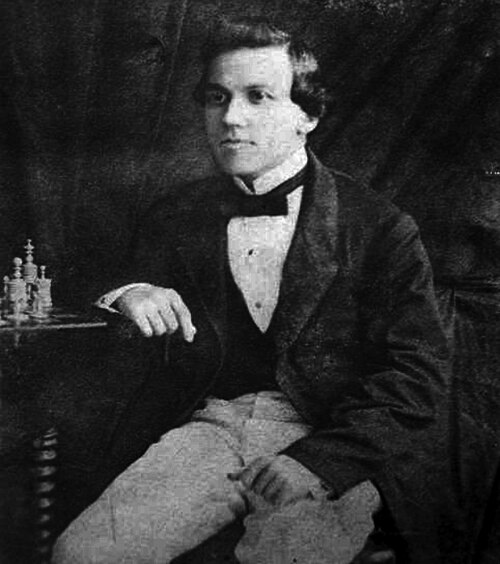
Paul Morphy (1837–1884) was an American chess genius who, in less than two years, beat nearly every strong player in the world. On a tour of Europe in 1858 he crushed the continent's best masters, and many people hailed him as world champion, although no official title existed yet. Then, at just 22, he stopped playing serious chess for good.
A child prodigy in New Orleans
Morphy was born on 22 June 1837 in New Orleans, Louisiana, into a wealthy family. His father was a lawyer and later a judge, and his mother, a gifted musician, came from a French Creole family. Paul seems to have learned chess simply by watching his relatives play. At the age of nine he beat General Winfield Scott, a famous army commander, in two games. By his early teens he was one of the best players in the United States.
He was a brilliant student, too. In April 1857 he finished a law degree at the University of Louisiana (today Tulane University), but he was still too young to work as a lawyer.
Champion of America
In late 1857 Morphy went to New York for the First American Chess Congress, a big tournament for the best players in the country. He won it, beating Louis Paulsen in the final. He was 20 years old.
The European tour of 1858
Morphy hoped to play Howard Staunton, England's best-known player, but that match never took place. So he played everyone else:
- In London he beat Johann Löwenthal by 9 wins to 3, with 2 draws.
- In Paris he beat Daniel Harrwitz. At the Café de la Régence he also played eight opponents at once blindfold, without seeing any of the boards.
- In December 1858, in Paris, he beat Adolf Anderssen, the winner of the great London tournament of 1851, by 7 wins to 2, with 2 draws. He was ill at the time.
When he came home in 1859 he was a national hero. At a ceremony in New York that May he was hailed as "Chess Champion of the World".
An early retirement
After 1859 Morphy never played another serious match or tournament. Nobody knows exactly why. In his time chess was seen as a gentleman's pastime, not a career, and he wanted to work as a lawyer, but his law practice never succeeded. He lived on his family's money, became more and more withdrawn, and showed signs of mental illness in later years. He died suddenly in New Orleans on 10 July 1884, aged 47, possibly from a stroke.
How Morphy played
Morphy was ahead of his time. Most players of the 1850s attacked straight away, often with only one or two pieces. Morphy understood that you should first develop, which means bringing your pieces out from their starting squares, then open lines in the centre, and only then attack. When he did attack, he often won with spectacular sacrifices, giving up material to reach the enemy king. These are the same opening principles coaches teach beginners today.
Famous game: the Opera Game, Paris 1858
Morphy's most famous game was played in a private box at the Italian Opera in Paris, in October or November 1858, while an opera was on stage. His opponents were two noblemen, Duke Karl II of Brunswick and Count Isouard, who chose their moves together. They played the Philidor Defence, the opening named after François-André Philidor, and soon fell behind in development. Morphy gave up a knight, then a rook, to open lines against the black king, and finished with a queen sacrifice.
The moves: 1.e4 e5 2.Nf3 d6 3.d4 Bg4 4.dxe5 Bxf3 5.Qxf3 dxe5 6.Bc4 Nf6 7.Qb3 Qe7 8.Nc3 c6 9.Bg5 b5 10.Nxb5 cxb5 11.Bxb5+ Nbd7 12.O-O-O Rd8 13.Rxd7 Rxd7 14.Rd1 Qe6 15.Bxd7+ Nxd7 16.Qb8+ Nxb8 17.Rd8# 1-0
Our Opera Game lesson goes through it move by move, and you can replay it on the analysis board.
Legacy
Morphy played top-level chess for only about two years, yet he is still counted among the greatest players ever. He showed the value of fast development long before anyone wrote it down as a rule. The first official world championship match was played in 1886, two years after his death, so he never held the title, but many historians treat him as the unofficial champion of his day. His story, a dazzling talent who suddenly left the game, is often compared with that of Bobby Fischer a century later.
Sources
- Paul Morphy, Wikipedia
- Paul Charles Morphy, World Chess Hall of Fame
- Opera Game, Wikipedia (circumstances and game score)
Checked in November 2026.
Questions and answers
- Was Paul Morphy a world champion?
- Not officially. The first official world championship match was played in 1886, two years after Morphy died. But after beating Europe's best players in 1858 he was widely hailed as the best in the world, so he is often called an unofficial world champion.
- Why did Paul Morphy quit chess?
- No one knows for sure. After returning to America in 1859 he never played another serious match. In his time chess was seen as a pastime rather than a career, and he tried, without success, to work as a lawyer.
- What is the Opera Game?
- A short game Morphy won in Paris in 1858 against the Duke of Brunswick and Count Isouard, who played together. It was played in a box at the opera and ends with a queen sacrifice and mate on move 17.
- How good was Paul Morphy?
- He won the 1857 American Chess Congress, then in 1858 beat Löwenthal, Harrwitz and Anderssen, the strongest players he could find in Europe, by big margins.
Play free now — no sign-up needed