 ChessMess
The Game of the Century: Byrne vs Fischer, 1956, explained
In 1956, 13-year-old Bobby Fischer beat Donald Byrne with a stunning queen sacrifice. The full game, the key moments explained simply, and why it's so famous.
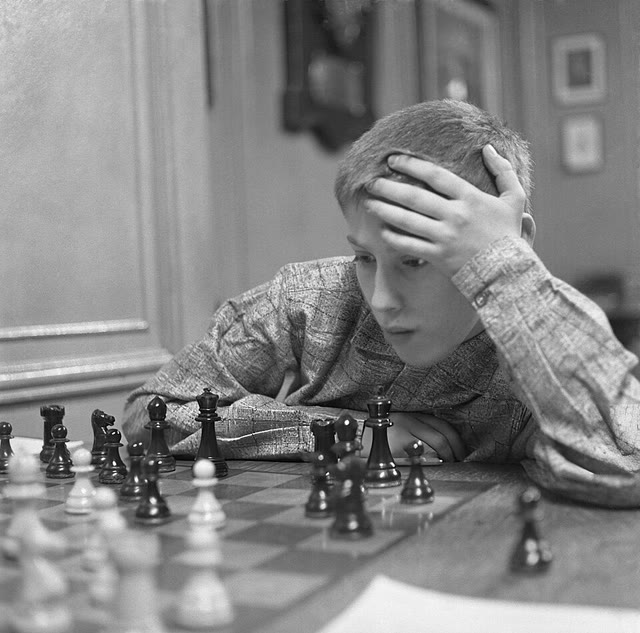
The "Game of the Century" is a chess game that 13-year-old Bobby Fischer won against Donald Byrne, one of the leading American masters, in New York on 17 October 1956. Playing Black, Fischer offered a knight on move 11 and gave up his queen on move 17, then hunted Byrne's king with his rooks, bishops and knight until he gave checkmate on move 41. The chess writer Hans Kmoch gave the game its famous name in the magazine Chess Review that December.
The players and the tournament
The game was played in round 8 of the third Rosenwald tournament, a strong invitation event in New York, at the famous Marshall Chess Club. Samuel Reshevsky, the best American player of the time, won the tournament. Fischer's overall result was only average, but this one game made him famous.
Donald Byrne (1930–1976) was one of the leading American players. He won the US Open in 1953, later became an International Master, and played for the United States in three Chess Olympiads.
Bobby Fischer (1943–2008) was a boy from Brooklyn who had only recently started to beat strong adults. Soon after this game he won the US Championship, became the world's youngest grandmaster at 15 in 1958, and in 1972 he became world champion. Read his full story on the Bobby Fischer page.
Moves 1–10: a calm start
Fischer chose the Grünfeld Defence. He let Byrne build a big pawn centre with d4 and e4, planning to attack it later with his pieces. By move 10 Fischer had castled and brought out most of his army. Byrne's queen had wandered to c5, and his king was still in the middle of the board.
11...Na4!!: a knight that can't be taken
On move 11 Byrne moved his bishop for the second time (11.Bg5) instead of bringing out his last pieces and castling. Most writers say 11.Be2, followed by castling, was correct. Fischer punished him at once with 11...Na4!!, putting his knight on a square where White's knight on c3 can take it.
Why can't Byrne take it? After 12.Nxa4, Fischer plays 12...Nxe4. His other knight now attacks White's queen on c5 and the bishop on g5 at the same time, and White's centre pawn on e4 is gone. In every line White either loses material or walks into a deadly pin (a piece that can't move because a more valuable piece stands behind it).
So Byrne moved his queen with 12.Qa3. Fischer swapped knights with 12...Nxc3 13.bxc3 and then grabbed the e4 pawn anyway with 13...Nxe4!, opening the e-file towards Byrne's uncastled king. After 14.Bxe7 Qb6 15.Bc4 Nxc3! 16.Bc5 Rfe8+ 17.Kf1, Byrne's bishop was attacking Fischer's queen on b6. One writer later reported that the masters watching thought Black was lost.
17...Be6!!: the queen sacrifice
Almost any player would simply move the queen to safety. Fischer instead played 17...Be6!!, leaving his queen to be captured. This is the move that made the game famous.
Here is what Fischer had seen:
- If 18.Bxe6, Black mates with 18...Qb5+ 19.Kg1 Ne2+ 20.Kf1 Ng3+ 21.Kg1 Qf1+!! 22.Rxf1 Ne2#. That is a smothered mate: the king is boxed in by its own pieces and a knight gives mate. Practise it with smothered mate puzzles.
- If 18.Qxc3, then 18...Qxc5! wins back material, and Black comes out ahead.
- If 18.Bxb6, as Byrne played, Fischer starts a "windmill".
The windmill: a run of checks
After 18.Bxb6 Bxc4+, Byrne's king can only step between f1 and g1. Fischer's knight and bishop now work like a windmill. Each time the knight lands on e2, it gives check itself. Each time it jumps away, it uncovers a check from the bishop on c4. This is called a discovered check. White never gets a free move to save anything:
19.Kg1 Ne2+ 20.Kf1 Nxd4+ 21.Kg1 Ne2+ 22.Kf1 Nc3+ 23.Kg1 axb6
Along the way Fischer picked up a pawn, and with 23...axb6 he captured the bishop that had taken his queen. Then 24.Qb4 Ra4! 25.Qxb6 Nxd1 won Byrne's rook too. For his queen, Fischer had now collected a rook, two bishops and a pawn, which is far more than enough. White's queen was alone on the queenside, and White's last rook was still stuck on h1. Learn this trick in the lesson on discovered attacks and double check.
The finish
Byrne played on until checkmate. According to a story one of his students told much later, Byrne did this on purpose, as a tribute to the boy's beautiful game. Fischer's pieces protected each other, closed in on the white king, and 41...Rc2 was mate.
Why it is so famous
- A 13-year-old beat a top master with ideas that grandmasters still admire. Chess.com's list of the best games of all time ranks it fifth.
- The queen sacrifice was real, not a trick. Fischer gave up the queen because he had worked out that the other choices were worse for White, and he got more than enough for it.
- It teaches simple lessons. Byrne lost time with his queen and bishop and left his king in the centre, while Fischer developed quickly and castled early. See the opening principles lesson.
- It announced a future champion. Within two years Fischer was a grandmaster, and in 1972 he won the world title.
Asked later how he had done it, Fischer said: "I just made the moves I thought were best. I was just lucky."
The full game
Donald Byrne vs Bobby Fischer, New York 1956 (Grünfeld Defence): 1.Nf3 Nf6 2.c4 g6 3.Nc3 Bg7 4.d4 O-O 5.Bf4 d5 6.Qb3 dxc4 7.Qxc4 c6 8.e4 Nbd7 9.Rd1 Nb6 10.Qc5 Bg4 11.Bg5 Na4 12.Qa3 Nxc3 13.bxc3 Nxe4 14.Bxe7 Qb6 15.Bc4 Nxc3 16.Bc5 Rfe8+ 17.Kf1 Be6 18.Bxb6 Bxc4+ 19.Kg1 Ne2+ 20.Kf1 Nxd4+ 21.Kg1 Ne2+ 22.Kf1 Nc3+ 23.Kg1 axb6 24.Qb4 Ra4 25.Qxb6 Nxd1 26.h3 Rxa2 27.Kh2 Nxf2 28.Re1 Rxe1 29.Qd8+ Bf8 30.Nxe1 Bd5 31.Nf3 Ne4 32.Qb8 b5 33.h4 h5 34.Ne5 Kg7 35.Kg1 Bc5+ 36.Kf1 Ng3+ 37.Ke1 Bb4+ 38.Kd1 Bb3+ 39.Kc1 Ne2+ 40.Kb1 Nc3+ 41.Kc1 Rc2# 0-1
Copy the moves into the analysis board and play through them yourself. Stop at moves 11 and 17 and ask what you would have played. For more great games, see famous chess games.
Sources
- Wikipedia: Game of the Century (chess)
- Edward Winter: Byrne v Fischer, Chess Notes
- Chess.com: The best chess games of all time
Checked in November 2026.
Questions and answers
- How old was Bobby Fischer in the Game of the Century?
- He was 13. The game was played on 17 October 1956, and Fischer was born in March 1943.
- Who did Bobby Fischer beat in the Game of the Century?
- Donald Byrne, one of the leading American masters of the 1950s, who had won the US Open in 1953 and later became an International Master.
- What was Fischer's queen sacrifice?
- On move 17 Fischer played 17...Be6 and let Byrne take his queen. In return he won a rook, two bishops and a pawn with a series of checks, and later checkmated Byrne's king.
- Who named it the Game of the Century?
- Hans Kmoch, who wrote about the game in the American magazine Chess Review in December 1956.
Play free now — no sign-up needed