 ChessMess
Bobby Fischer: the American prodigy who became world champion
Bobby Fischer (1943–2008) was a chess prodigy at 13 and became world champion in 1972 by beating Boris Spassky in Reykjavik. His story and his best game.
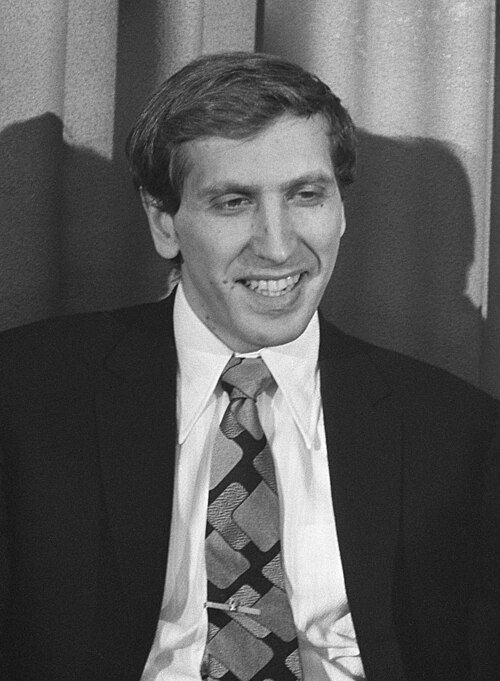
Bobby Fischer was the American chess prodigy who became the 11th world champion. In 1972 he beat Boris Spassky of the Soviet Union in Reykjavík, Iceland, in a match that made front pages around the world. He played with fierce energy and crystal-clear ideas, and for a few years he was far ahead of every other player. Then, at the peak of his fame, he stopped playing.
A prodigy from Brooklyn
Robert James Fischer was born in Chicago on 9 March 1943 and grew up in Brooklyn, New York. In March 1949, aged six, he and his sister Joan learned the moves from the instructions in a chess set bought at a sweet shop. In July 1956, at 13, he became the youngest-ever US Junior Champion. In October 1956 he beat Donald Byrne in New York with a stunning queen sacrifice, in a game that became known as the Game of the Century.
He won the US Championship at 14, the first of a record eight titles. In the 1963–64 championship he won all 11 of his games, the only perfect score in the event's history. In 1958, at 15, he became a grandmaster, the highest title in chess. No one had ever earned it so young.
The road to the title
In 1970–71 Fischer finally got his chance in the Candidates matches, the knockout matches that decided who would challenge the champion. What happened shocked the chess world. He beat Mark Taimanov 6–0 and Bent Larsen 6–0, scores almost unheard of between top grandmasters. Then he beat former champion Tigran Petrosian 6½–2½.
Reykjavík 1972
The match against Spassky ran from July to September 1972. It was the time of the Cold War, so newspapers presented it as the United States against the Soviet Union. It began badly for Fischer. He lost the first game, then refused to play the second because of a dispute about cameras in the hall, and lost that game by forfeit. Many people thought the match was over. Instead, Fischer won 12½–8½ and became world champion. On FIDE's rating list of July 1972 he stood at 2785, a full 125 points above Spassky, the world No. 2.
After the title
Fischer never played a match as champion. In 1975 he and FIDE, the World Chess Federation, could not agree on the rules for his title defence against Anatoly Karpov. Fischer did not play, and FIDE declared Karpov champion. Fischer then disappeared from public chess for twenty years.
In 1992 he played an unofficial rematch against Spassky in Yugoslavia, a country then under United Nations sanctions. He won, but the US government said the match broke those sanctions and issued a warrant for his arrest. He lived abroad from then on. In 2004 he was detained in Japan, accused of travelling on a cancelled US passport, and in March 2005 Iceland, the country of his greatest triumph, made him a citizen. In his later years he also made many hateful public statements, including antisemitic ones, which were widely condemned. He died in Reykjavík on 17 January 2008, aged 64.
Fischer also left two lasting inventions. He patented a chess clock that adds a little time after every move, called an increment, which is now normal in top events. And in 1996 he introduced Fischer Random chess, also called Chess960, in which the pieces on the back row start in a shuffled order, so players cannot rely on memorised openings.
How Fischer played
Fischer's chess was clear and energetic. He liked open positions where his pieces could move freely, and he played every game to win, even with Black. He knew his favourite openings more deeply than anyone. His moves often look simple, but that simplicity came from very precise calculation.
Famous game: Fischer vs Spassky, game 6, 1972
Fischer almost always began with 1.e4. In game 6 he surprised everyone with 1.c4 and moved into a Queen's Gambit, a classic opening he had never played with White in a serious game. Spassky chose a defence he had never lost with. On move 20 Fischer pushed his e-pawn to e4 and broke up Black's pawns in the centre.
Spassky answered by pushing his d-pawn to d4. That left his own pawns stuck and gave White's bishop a free road. Fischer then pushed his f-pawn and e-pawn, opened lines towards Black's king and brought his rooks and queen into the attack. On move 41 Spassky resigned.
When the game ended, Spassky joined the audience in applauding Fischer. Play through the moves on the analysis board, and see our lesson on the Queen's Gambit for the ideas behind the opening.
Legacy
Fischer's run to the title made chess popular in the United States as never before, and his match with Spassky is still the most famous in chess history. His book My 60 Memorable Games is a classic. His clock with an increment and his shuffled-start chess are both used at the highest level today. See where he fits among all the title holders on our World Chess Champions page.
Sources
- Bobby Fischer, Wikipedia
- World Chess Championship 1972, Wikipedia (match details and the score of game 6, from Chess Informant 14)
- Bobby Fischer: ich bin ein Icelander!, ChessBase, March 2005
Checked in November 2026.
Questions and answers
- Why did Bobby Fischer give up his world title?
- In 1975 he and FIDE could not agree on the rules for his title defence against Anatoly Karpov. Fischer did not play, so FIDE declared Karpov the new world champion.
- How old was Bobby Fischer when he played the Game of the Century?
- He was 13. He beat Donald Byrne in New York in October 1956 with a famous queen sacrifice.
- What was Bobby Fischer's highest rating?
- 2785, on FIDE's rating list of July 1972. That was 125 points more than Boris Spassky, the world No. 2 at the time.
- What is Fischer Random chess?
- A version of chess that Fischer introduced in 1996. The pieces on the back row start in a shuffled order, with 960 possible set-ups, so players must think for themselves from the first move. It is also called Chess960.
Play free now — no sign-up needed