 ChessMess
François-André Philidor: chess master, composer and pawn pioneer
François-André Philidor (1726–1795) was the best chess player of his age and a famous composer. His life, his pawn ideas, his blindfold play and a model game.
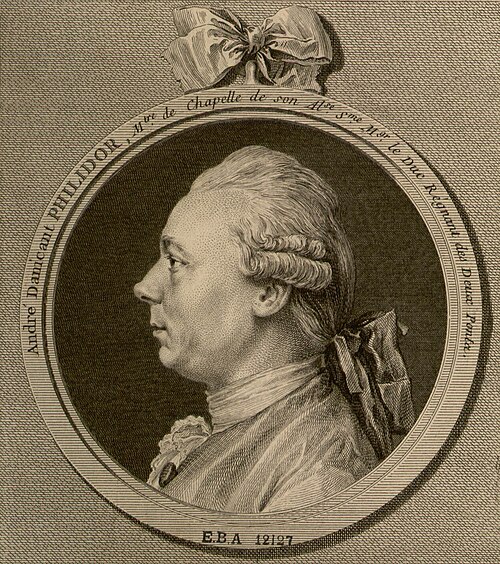
François-André Danican Philidor (1726–1795) was the strongest chess player of the 18th century and, at the same time, one of the most popular composers in France. His book of 1749 was the first to explain that pawns shape the whole game, an idea every chess coach still teaches. He also amazed London by playing several games at once without looking at a board.
Music and coffee houses
Philidor was born on 7 September 1726 in Dreux, a town west of Paris, into a family of royal musicians. As a boy he sang in the king's chapel at Versailles, and the musicians there taught him chess. As a teenager he moved to Paris and earned a living by teaching and copying music.
In his free time he went to the Café de la Régence, the most famous chess café in Paris. The café's resident chess master, Legall, became his teacher. Before long, Philidor was beating him.
The best player in Europe
In 1747 Philidor travelled to London. At Old Slaughter's Coffee House, a meeting place for English players, he beat the best players he could find, including Philipp Stamma, a well-known chess author. From then on he was seen as the strongest player in Europe.
In 1749, while still in his early twenties, he published his book L'Analyze des Echecs ("Analysis of Chess") in London. It became one of the most successful chess books ever: by 1871 it had gone through about 70 editions and translations. In 1750 King Frederick the Great of Prussia invited him to his palace at Sanssouci, near Berlin. Back in Paris, in 1755, he beat his old teacher Legall in a match.
A famous composer
For many years Philidor spent more time on music than on chess. He wrote more than 20 comic operas, and works such as Le sorcier (1764) and Tom Jones (1765) made him famous across France.
From the 1770s, London chess clubs paid him to spend part of each year there, playing and teaching. The best known was the club at Parsloe's in St James's Street. In 1792, during the French Revolution, his name was put on a list of people banned from France, probably because his family had served the king. He could not go home. He stayed in London, kept playing chess, and died there on 31 August 1795.
His big idea: pawns
Before Philidor, most players treated pawns as small change. They gave them away to open lines for a quick attack on the king. Philidor saw it the other way round. In the preface of his book he wrote that pawns "are the soul of chess" (in his French, "l'âme des Echecs"). He meant that the way your pawns stand decides where your pieces can go, which side can attack, and who wins the endgame.
This was the start of what players now call pawn structure. Philidor showed how pawns standing side by side in the centre can push forward together, and how a passed pawn, one with no enemy pawn able to stop it, can win the game on its own. His book also studied endgames. A key drawing method in rook endgames is still called the Philidor position, and the opening 1.e4 e5 2.Nf3 d6 is called the Philidor Defence.
Chess without seeing the board
Philidor was just as famous for blindfold chess: playing without seeing the board and keeping the whole position in your head. In London he gave many displays of two or three blindfold games at the same time. On 9 May 1783, at the chess club in St James's Street, he played three at once. Some of the people present signed written statements about it, because they feared later readers would not believe it. Strong players today can do much more, but in the 1700s it seemed close to magic.
Famous game: Count Brühl vs Philidor, London 1783
Count Hans Moritz von Brühl, a diplomat from Saxony who lived in London, was one of Philidor's regular opponents. In this game Philidor had the black pieces, and it shows his ideas perfectly. He built a strong pawn centre, swapped pieces when it suited him, and then let his pawns decide the game. On move 38 a neat trick won a pawn. After that, his e-pawn and f-pawn, standing side by side, rolled down the board, and White's rook could not stop them both.
The moves: 1.e4 e5 2.Bc4 c6 3.Qe2 d6 4.c3 f5 5.d3 Nf6 6.exf5 Bxf5 7.d4 e4 8.Bg5 d5 9.Bb3 Bd6 10.Nd2 Nbd7 11.h3 h6 12.Be3 Qe7 13.f4 h5 14.c4 a6 15.cxd5 cxd5 16.Qf2 O-O 17.Ne2 b5 18.O-O Nb6 19.Ng3 g6 20.Rac1 Nc4 21.Nxf5 gxf5 22.Qg3+ Qg7 23.Qxg7+ Kxg7 24.Bxc4 bxc4 25.g3 Rab8 26.b3 Ba3 27.Rc2 cxb3 28.axb3 Rbc8 29.Rxc8 Rxc8 30.Ra1 Bb4 31.Rxa6 Rc3 32.Kf2 Rd3 33.Ra2 Bxd2 34.Rxd2 Rxb3 35.Rc2 h4 36.Rc7+ Kg6 37.gxh4 Nh5 38.Rd7 Nxf4 39.Bxf4 Rf3+ 40.Kg2 Rxf4 41.Rxd5 Rf3 42.Rd8 Rd3 43.d5 f4 44.d6 Rd2+ 45.Kf1 Kf7 46.h5 e3 47.h6 f3 0-1
You can paste these moves into the analysis board and play through them with an engine.
Legacy
Philidor's book stayed in print, in many languages, for more than a century, and his name lives on in an opening and an endgame. More than a century after his book, Paul Morphy won his famous Opera Game against the Philidor Defence. He lived long before the first official world chess champions, but today he is remembered as the first great chess thinker: the man who saw that chess is not only about attacking the king, but about building a good position, starting with the pawns.
Sources
- François-André Danican Philidor, Wikipedia
- Philidor at 300: Chess Master, Musician and Pioneer by André Schulz, ChessBase, September 2026 (also the source of the game score)
- Philidor: "Pawns are the soul of chess" by Edward Winter, Chess Notes
- François-André Danican Philidor by Edward Winter, Chess Notes
Checked in November 2026.
Questions and answers
- Who was Philidor in chess?
- François-André Danican Philidor (1726–1795) was a French chess master and composer. He is widely seen as the strongest player of the 18th century, and his 1749 book taught the importance of pawns.
- Who said 'pawns are the soul of chess'?
- Philidor. In the preface of his book L'Analyze des Echecs (London, 1749) he wrote that pawns are the soul of chess, in French 'l'âme des Echecs'.
- What is the Philidor Defence?
- It is the opening 1.e4 e5 2.Nf3 d6, named after Philidor. Black protects the e5 pawn with another pawn instead of a piece. Paul Morphy's famous Opera Game began with it.
- Was Philidor a world champion?
- No. There was no official world championship until 1886. But in his own time Philidor was regarded as the best player in Europe, and historians often call him the strongest player of the 1700s.
Play free now — no sign-up needed