 ChessMess
World chess champions: the full list from Steinitz to Gukesh
Every world chess champion from Wilhelm Steinitz in 1886 to Gukesh, how each won the title, FIDE's split title of 1993–2006 and the 2026 title match.
As of November 2026, the world chess champion is Gukesh Dommaraju of India. He won the title in December 2024 by beating Ding Liren, and he is the 18th undisputed world champion since Wilhelm Steinitz won the first official title match in 1886. From 24 November 2026 Gukesh defends his title against Javokhir Sindarov of Uzbekistan in Geneva, Switzerland.
All the world champions
| # | Champion | Country | Years as champion | How they won the title |
|---|---|---|---|---|
| 1 | Wilhelm Steinitz | Austria, later USA | 1886–1894 | Beat Johannes Zukertort in the first official title match (USA, 1886) |
| 2 | Emanuel Lasker | Germany | 1894–1921 | Beat Steinitz (1894) |
| 3 | José Raúl Capablanca | Cuba | 1921–1927 | Beat Lasker in Havana (1921) |
| 4 | Alexander Alekhine | France (born in Russia) | 1927–1935, 1937–1946 | Beat Capablanca in Buenos Aires (1927); won the title back from Euwe (1937) |
| 5 | Max Euwe | Netherlands | 1935–1937 | Beat Alekhine (1935) |
| 6 | Mikhail Botvinnik | Soviet Union | 1948–1957, 1958–1960, 1961–1963 | Won FIDE's five-player championship tournament (1948); won return matches in 1958 and 1961 |
| 7 | Vasily Smyslov | Soviet Union | 1957–1958 | Beat Botvinnik (1957) |
| 8 | Mikhail Tal | Soviet Union | 1960–1961 | Beat Botvinnik (1960) |
| 9 | Tigran Petrosian | Soviet Union | 1963–1969 | Beat Botvinnik (1963) |
| 10 | Boris Spassky | Soviet Union | 1969–1972 | Beat Petrosian (1969) |
| 11 | Bobby Fischer | USA | 1972–1975 | Beat Spassky in Reykjavík, Iceland (1972) |
| 12 | Anatoly Karpov | Soviet Union | 1975–1985 | Declared champion when Fischer did not defend (1975) |
| 13 | Garry Kasparov | Soviet Union, later Russia | 1985–2000 | Beat Karpov in Moscow (1985) |
| 14 | Vladimir Kramnik | Russia | 2000–2007 | Beat Kasparov in London (2000); won the 2006 reunification match |
| 15 | Viswanathan Anand | India | 2007–2013 | Won the eight-player championship tournament in Mexico City (2007) |
| 16 | Magnus Carlsen | Norway | 2013–2023 | Beat Anand in Chennai (2013) |
| 17 | Ding Liren | China | 2023–2024 | Beat Ian Nepomniachtchi in Astana (2023) after Carlsen gave up the title |
| 18 | Gukesh Dommaraju | India | 2024– | Beat Ding Liren in Singapore (2024) |
From 1993 to 2006 the title was split in two: Kasparov and then Kramnik held the "classical" title outside FIDE, while FIDE crowned its own champions (see the second table below).
Before 1886: a best player, but no title
For centuries people argued about who was the best player in the world, but there was no official title. François-André Philidor in the 1700s, and Howard Staunton, Adolf Anderssen and Paul Morphy in the 1800s, were each seen as the strongest of their time. That changed in 1886, when Steinitz and Johannes Zukertort played a match that was billed as being for the championship of the world. It was played in New York, St Louis and New Orleans, and Steinitz won 12½–7½. How chess got from coffeehouses to title matches is told in chess from coffeehouses to world championships.
The early title matches (1886–1946)
In those years no organisation controlled the title. The champion owned it. He decided whom to play, when, and for how much money, and a challenger usually needed rich supporters to raise the stakes.
- Lasker held the title for 27 years (1894–1921), the longest reign in history.
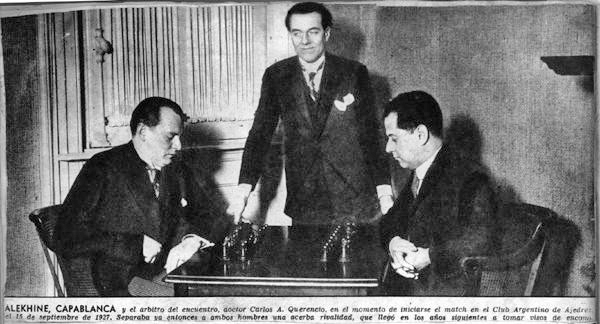
- Capablanca wrote the "London Rules" in 1922. Among other things, a challenger had to raise a prize fund of at least 10,000 US dollars. The only match ever played under these rules was Capablanca against Alekhine in 1927. Alekhine won, and the talks about a return match dragged on for years without result.
- Euwe beat Alekhine in 1935, but Alekhine won the rematch in 1937.
- Alekhine died in 1946 while still champion. He is the only world champion to die holding the title.
FIDE takes over (1948)
FIDE, the international chess federation, was founded in Paris in 1924. After Alekhine's death it took charge of the title. In 1948 it held a championship tournament for five of the world's best players, played in The Hague and Moscow, and Mikhail Botvinnik won it. From then on FIDE ran a regular cycle: qualifying events, then a Candidates contest to find a challenger, then a title match against the champion, roughly every three years.
Soviet players held the title without a break from 1948 until 1972, when Bobby Fischer beat Boris Spassky in Reykjavík at the height of the Cold War. In 1975 Fischer refused to defend his title on FIDE's terms, and Anatoly Karpov became champion without playing a match. Karpov and Garry Kasparov then played five title matches between 1984 and 1990. The first was stopped after 48 games without a result, and Kasparov won the rematch in 1985.
Two champions: the split of 1993–2006
In 1993 Kasparov and his challenger, Nigel Short, fell out with FIDE over the prize money and the way FIDE was run. They left and played their match under a new organisation, the Professional Chess Association. FIDE took its title away from Kasparov and held its own match, in which Karpov beat Jan Timman.
So for 13 years there were two "world champions". The classical line passed from Kasparov (who beat Short in 1993 and Anand in 1995) to Vladimir Kramnik, who beat Kasparov in London in 2000 without losing a game and kept the title by drawing a match with Peter Leko in 2004. FIDE, meanwhile, crowned these champions, mostly through big knockout events with short mini-matches and fast tiebreak games:
| FIDE champion | Country | Years | How they won |
|---|---|---|---|
| Anatoly Karpov | Russia | 1993–1999 | Beat Jan Timman (1993); kept the title against Gata Kamsky (1996) and Viswanathan Anand (1998) |
| Alexander Khalifman | Russia | 1999–2000 | Won a knockout event in Las Vegas |
| Viswanathan Anand | India | 2000–2002 | Won a knockout event in New Delhi and Tehran |
| Ruslan Ponomariov | Ukraine | 2002–2004 | Won a knockout event in Moscow |
| Rustam Kasimdzhanov | Uzbekistan | 2004–2005 | Won a knockout event in Tripoli, Libya |
| Veselin Topalov | Bulgaria | 2005–2006 | Won an eight-player tournament in San Luis, Argentina |
One champion again (2006)
In 2006 the two lines were joined. Kramnik, the classical champion, played Topalov, the FIDE champion, in Elista, Russia. The main games ended 6–6, and Kramnik won the rapid tiebreak 2½–1½ to become the first undisputed champion since 1993. In 2007 FIDE held an eight-player tournament in Mexico City for the title, and Viswanathan Anand won it. He then defended the title in matches against Kramnik (2008), Topalov (2010) and Boris Gelfand (2012).
From Carlsen to Gukesh
Magnus Carlsen beat Anand in Chennai in 2013. He defended the title four times: against Anand (2014), Sergey Karjakin (2016), Fabiano Caruana (2018) and Ian Nepomniachtchi (2021). In 2022 he said he would not play another title match, so in 2023 the title went to the winner of a match between Nepomniachtchi, the winner of the 2022 Candidates, and Ding Liren, who finished second. Ding won in a rapid tiebreak in Astana and became the first world champion from China.
In 2024 Gukesh won the Candidates tournament in Toronto and then beat Ding 7½–6½ in Singapore, winning the 14th and final game. At 18 he became the youngest undisputed world champion in history, beating Kasparov's record (Kasparov was 22), and the second Indian champion after Anand.
The 2026 title match: Gukesh against Sindarov
This is the situation as of 9 November 2026:
- The challenger. Javokhir Sindarov of Uzbekistan won the 2026 Candidates tournament in Cyprus, held in March and April, with 10 points from 14 games. That was the highest score in modern Candidates history. He made sure of first place with a round to spare, and Anish Giri finished second with 8½.
- The match. It is played at the Fondation Martin Bodmer in Cologny, Geneva. The official programme runs from 22 November to 12 December 2026, and the first game is on 24 November.
- The format. Up to 14 classical games. The first player to reach 7½ points wins. If the score is 7–7, faster tiebreak games decide the title on 12 December.
- The players. Both are about 20 years old, which makes this the youngest world championship match in history.
We will update this page with the result. For the women's title, see women's world chess champions.
Sources
- World champions, FIDE Chess Museum
- List of World Chess Championships, Wikipedia: every match, place and score
- World Chess Championship, Wikipedia: the London Rules, 1948 and the 1993–2006 split
- Indian teen prodigy Gukesh becomes youngest world chess champion, Dawn, 13 December 2024
- Sindarov wins Candidates with round to spare, Chess.com, 14 April 2026
- Vaishali wins Women's Candidates; Sindarov breaks record, Chess.com, April 2026
- Salesforce FIDE World Championship Match 2026: schedule, format and prize fund confirmed, FIDE, 14 September 2026
Checked in November 2026.
Questions and answers
- Who is the current world chess champion?
- As of November 2026 it is Gukesh Dommaraju of India, who beat Ding Liren in December 2024. He defends the title against Javokhir Sindarov of Uzbekistan in Geneva from 24 November 2026.
- Who was the first world chess champion?
- Wilhelm Steinitz. He beat Johannes Zukertort in 1886 in the first match played for the world championship, and he kept the title until 1894.
- How many world chess champions have there been?
- There have been 18 undisputed world champions, from Steinitz to Gukesh. During the split from 1993 to 2006, four more players held only FIDE's version of the title: Khalifman, Ponomariov, Kasimdzhanov and Topalov.
- Who held the world chess title the longest?
- Emanuel Lasker, who was world champion for 27 years, from 1894 to 1921.
- Who is the youngest world chess champion?
- Gukesh Dommaraju, who won the title at 18 in December 2024. The previous record belonged to Garry Kasparov, who became champion at 22.
Play free now — no sign-up needed