 ChessMess
Famous people who played chess: from Franklin to Kubrick
Benjamin Franklin, Napoleon, Marcel Duchamp, Prokofiev, Bogart, Kubrick, Satyajit Ray and Alan Turing all loved chess. What is true, and which stories are myths.
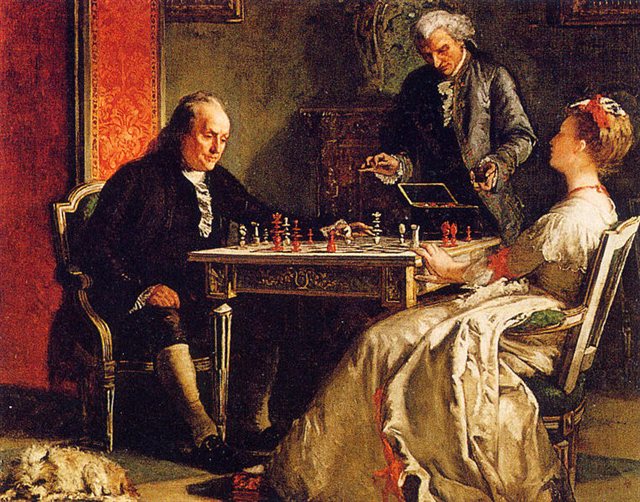
Chess has never belonged only to professional players. One of the founders of the United States, a great Russian composer, two film legends, one of India's greatest film directors and the scientists who started the computer age all loved the game. Here are their stories, checked against reliable sources, and a few famous tales that turn out to be myths.
Benjamin Franklin and "The Morals of Chess"
Benjamin Franklin (1706–1790), the American printer, scientist and statesman, played chess for most of his life. In his autobiography he says that as a young man he learned Italian with a friend through chess: they played on the condition that the winner could set the loser some grammar or translation homework.
While he was the American envoy in France, Franklin wrote a short essay called The Morals of Chess (by 1779). It first reached American readers in 1786, in the Columbian Magazine. Its message is that chess trains habits that help in life: thinking ahead, looking at the whole situation, being careful, and not giving up when things go badly.
Chess even played a small part in politics. In London in 1774, Franklin played chess with Caroline Howe, the sister of Admiral Richard Howe, and these games led to quiet talks with the admiral about avoiding war between Britain and the American colonies. The talks came to nothing.
How strong was he? Nobody knows, because none of his games was written down. The painting at the top of this page was made in 1867, long after his death, so it shows an imagined scene.
Napoleon: keen, but not very good
Napoleon Bonaparte (1769–1821) played chess often. People who watched him agreed that he was a weak player. His secretary Bourrienne called him third-rate, and the chess historian H. J. R. Murray described him as persistent but very weak.
Old chess books print three "Napoleon games": against Madame de Rémusat (said to be from 1804), against General Bertrand on St Helena, and against the famous chess-playing "machine" called the Turk. All three are doubtful. The Bertrand game comes from a magazine sketch that was partly fiction, and the other two first appeared in print decades after they were supposedly played. As the chess historian Edward Winter puts it, "nice stories are not chess history."
Marcel Duchamp: the artist who played for France
The French artist Marcel Duchamp (1887–1968) is famous for turning everyday objects into art. He was also a serious tournament player. He took part in the French Championship in the 1920s, and he played for France at four Chess Olympiads, the team world championship: The Hague 1928, Hamburg 1930, Prague 1931 and Folkestone 1933. In 1933 his team was led by the world champion, Alexander Alekhine.
In 1932 Duchamp and Vitaly Halberstadt published a book about rare king-and-pawn endgames, L'opposition et les cases conjuguées sont réconciliées ("Opposition and sister squares are reconciled"). The opposition is a key idea in pawn endings; you can learn it in the opposition lesson.
Sergei Prokofiev: beating a future world champion
The Russian composer Sergei Prokofiev (1891–1953), who wrote Peter and the Wolf, was a strong amateur. In 1914 the young Cuban master José Raúl Capablanca gave three simultaneous exhibitions in St Petersburg, playing many opponents at once. Prokofiev played in all three. He lost the first two games and won the third. Capablanca became world champion seven years later, in 1921.
Prokofiev also played a friendly match against the great violinist David Oistrakh, with a fun prize rule: the loser had to give a concert for the members of their club. World champion Mikhail Botvinnik remembered Prokofiev as a direct, attacking player who did not much care for defending.
Humphrey Bogart: chess between scenes
Humphrey Bogart (1899–1957), star of Casablanca, loved chess. While Casablanca was being filmed, he played between scenes with his fellow actors Sydney Greenstreet and Helmut Dantine. During the Second World War he also played games by post with soldiers. In 1945 he appeared on the cover of the magazine Chess Review with Lauren Bacall, Charles Boyer and the chess master Herman Steiner.
Be careful with the short game sometimes printed as "Limbos v Bogart". Edward Winter treats it only as an "alleged" game, so it is not proof of anything.
Stanley Kubrick: chess for money in the park
The film director Stanley Kubrick (1928–1999), who made Dr. Strangelove and 2001: A Space Odyssey, told the physicist and writer Jeremy Bernstein that early in his career he played chess for money in Washington Square Park in New York. When the two played each other, Kubrick won the first four games. A well-known photo shows Kubrick playing chess with the actor George C. Scott on the set of Dr. Strangelove.
Satyajit Ray: The Chess Players
Satyajit Ray (1921–1992), one of India's greatest film directors, made Shatranj Ke Khilari (The Chess Players, 1977), his only full-length feature film in Hindi and Urdu. It is based on a short story by Munshi Premchand. It is set in Lucknow in 1856, where two rich noblemen are so lost in their chess games that they ignore the British takeover of their kingdom, Awadh.
The film was personal. The historian Vinay Lal notes that Ray was drawn to the story by his interest in chess, the British Raj and Lucknow, and that perhaps only his close friends knew about his passion for the game. Read more about chess in India in chess in India.
Alan Turing and Claude Shannon: teaching machines to play
Two of the founders of computer science were fascinated by chess.
- Alan Turing (1912–1954), the British mathematician, wrote a chess program with David Champernowne in 1948. No computer at the time could run it, so in 1952 Turing played it against Alick Glennie by working out every move himself with pencil and paper; each move took him more than half an hour. The "paper machine" lost in 29 moves. In 2012 Garry Kasparov played and beat a computer rebuild of Turing's program.
- Claude Shannon (1916–2001), the American mathematician and engineer, published "Programming a Computer for Playing Chess" in 1950. In it he estimated that chess has around 10^120 possible games, far too many for any computer to check one by one. That rough figure is now called the Shannon number.
Their ideas led, step by step, to the engines that beat world champions. That story is in chess and computers.
Myths to watch out for
- Napoleon's games: all three famous "Napoleon games" are doubtful; he was a keen but weak player.
- Bogart's famous win: the short game credited to him is only an alleged game.
- Franklin the chess master: he loved the game and wrote about it, but none of his games survives, so nobody can say how strong he was.
Sources
- Benjamin Franklin: diplomat, libertine, chess master, HistoryNet
- Edward Winter, Chess Notes feature articles: Napoleon Bonaparte, Marcel Duchamp, Sergei Prokofiev and chess and Hollywood
- OlimpBase, France's teams and results at the Olympiads of 1928, 1930, 1931 and 1933
- Playing chess with Kubrick, Jeremy Bernstein, The New York Review of Books
- The Chess Players, Vinay Lal, UCLA, and Shatranj Ke Khilari, satyajitray.org
- Reconstructing Turing's "paper machine", ChessBase
- Programming a Computer for Playing Chess, Claude Shannon, 1950 (text of the paper)
Checked in November 2026.
Questions and answers
- Which famous people played chess?
- Well-documented examples include Benjamin Franklin, Napoleon Bonaparte, the artist Marcel Duchamp, the composer Sergei Prokofiev, the actor Humphrey Bogart, the directors Stanley Kubrick and Satyajit Ray, and the scientists Alan Turing and Claude Shannon.
- Was Napoleon good at chess?
- No. People who knew him said he was a keen but weak player, and the three games often printed under his name are considered doubtful by chess historians.
- Was Marcel Duchamp a serious chess player?
- Yes. He played in the French Championship and represented France at four Chess Olympiads between 1928 and 1933, and he co-wrote a book on endgames in 1932.
- What is Shatranj Ke Khilari about?
- It is Satyajit Ray's 1977 film, based on a story by Munshi Premchand. Two noblemen in Lucknow in 1856 play chess while the British take over their kingdom, Awadh.
- Who wrote The Morals of Chess?
- Benjamin Franklin wrote it in France by 1779. It was first printed for American readers in the Columbian Magazine in 1786.
Play free now — no sign-up needed