 ChessMess
Garry Kasparov: world chess champion from 1985 to 2000
Garry Kasparov was world champion from 1985 to 2000 and world No. 1 for a record 255 months. His Karpov matches, Deep Blue and his finest game.
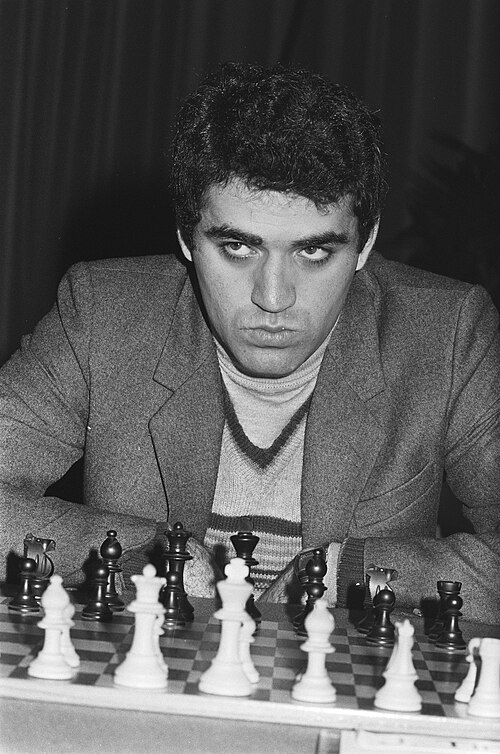
Garry Kasparov was the 13th world chess champion and, for about twenty years, the strongest player on the planet. He took the title from Anatoly Karpov in 1985, at 22, and held it until 2000. From 1984 until he retired in 2005 he was world No. 1 on FIDE's rating list for a record 255 months in total. His chess was powerful, deeply prepared and full of energy, and he also became the face of humans against chess computers.
From Baku to the top
Kasparov was born on 13 April 1963 in Baku, Azerbaijan, then part of the Soviet Union. At ten he began training at Mikhail Botvinnik's chess school. At 15 he was already playing in the Soviet Championship, the youngest player ever to qualify for it. In 1980 he won the World Junior Championship and became a grandmaster, the highest title in chess, aged 17.
Five matches with Karpov
In 1984 Kasparov challenged Anatoly Karpov. Their first match lasted five months and 48 games. It was stopped without a result in February 1985, with Karpov leading 5–3. In the new match later that year Kasparov won 13–11 and became champion on 9 November 1985. At 22 he was the youngest undisputed world champion in history, a record that stood until Gukesh Dommaraju won the title in 2024, aged 18.
They played three more title matches, in 1986, 1987 and 1990. Each one was close, and each time Kasparov kept his title. Over five matches and 144 games, Kasparov won 21 games to Karpov's 19, with 104 draws.
A split title
In 1993 Kasparov and his challenger Nigel Short broke away from FIDE, the World Chess Federation, and played their match under a new body, the Professional Chess Association. Kasparov won. From then until 2006 there were two "world champions": FIDE's champion, and the "classical" line that ran through Kasparov. He beat Viswanathan Anand in 1995. In 2000 he lost his title to Vladimir Kramnik in London, 8½–6½, without winning a single game.
He stayed world No. 1 anyway. His rating reached 2851 on FIDE's July 1999 list, the highest ever at that time; only Magnus Carlsen has gone higher since. He kept winning top tournaments and announced his retirement from regular play on 10 March 2005, right after winning in Linares. Since then he has been best known as a writer and a political activist.
Man against machine
Kasparov's matches against IBM's computer Deep Blue made world news. He won the first match in Philadelphia in 1996, 4–2. In the 1997 rematch in New York, Deep Blue won 3½–2½, the first time a computer beat a reigning world champion in a match. That story is told on our page about Deep Blue vs Kasparov 1997.
How Kasparov played
Kasparov played dynamic chess. "Dynamic" means he valued active pieces and the initiative, the power to make threats and force the opponent to react, more than safe extra material. He would give up a pawn, or even more, to make his pieces work together. He also took opening preparation to a new level, arriving at the board with ideas worked out far into the middle of the game. His most famous attack, against Veselin Topalov in 1999, has its own page: Kasparov vs Topalov 1999.
Famous game: Karpov vs Kasparov, game 16, 1985
In game 16 of the 1985 match Kasparov had Black and played the Sicilian Defence. Early on he gave up a pawn to get his pieces out quickly. On move 16 his knight jumped to d3, deep inside White's position.
A knight on a square where enemy pawns can never attack it is said to stand on an outpost; our lesson on outposts explains why they are so strong. This knight cut White's position in two. Karpov's knights soon ended up on a4 and b1, far from the action, and his queen and rooks could not get going. The knight stayed on d3 until move 34, when Karpov gave up his queen to get rid of it. Kasparov then broke through, and Karpov resigned after 40...Re1+.
Readers of Chess Informant, a leading chess publication, later chose this as the best game of its first 64 volumes. Replay it on the analysis board.
Legacy
Kasparov helped change how top players work. Deep home preparation, and later computer analysis, became part of every champion's routine. His long reign, his record time at No. 1, and his battles with Karpov and with Deep Blue made him one of the most famous chess players of all time. See all the title holders on our World Chess Champions page.
Sources
- Garry Kasparov, Wikipedia
- World Chess Championship 1985, Wikipedia (match details and the score of game 16)
- Karpov–Kasparov rivalry, Wikipedia
- Magnus Carlsen Reaches 15 Years Unbroken As World No. 1, Chess.com, July 2026 (Kasparov's 255 months at No. 1)
- Garry Kasparov, FIDE rating profile
Checked in November 2026.
Questions and answers
- How long was Garry Kasparov world champion?
- From 1985 to 2000. He beat Anatoly Karpov in 1985 and lost the title to Vladimir Kramnik in 2000. From 1993 his title was the 'classical' one, separate from FIDE's.
- Did Kasparov lose to a computer?
- Yes. He beat IBM's Deep Blue 4–2 in 1996, but lost the 1997 rematch 3½–2½. It was the first time a computer beat a reigning world champion in a match.
- What was Garry Kasparov's highest rating?
- 2851, on FIDE's rating list of July 1999. It was the highest rating ever until Magnus Carlsen passed it.
- How old was Kasparov when he became world champion?
- He was 22 when he beat Karpov on 9 November 1985. He was the youngest undisputed champion until Gukesh Dommaraju won the title at 18 in 2024.
Play free now — no sign-up needed