 ChessMess
Mikhail Tal: the Magician from Riga and his daring sacrifices
Mikhail Tal (1936–1992), the Magician from Riga, won the world title in 1960 with wild attacking chess. His life, his style and his most famous game.
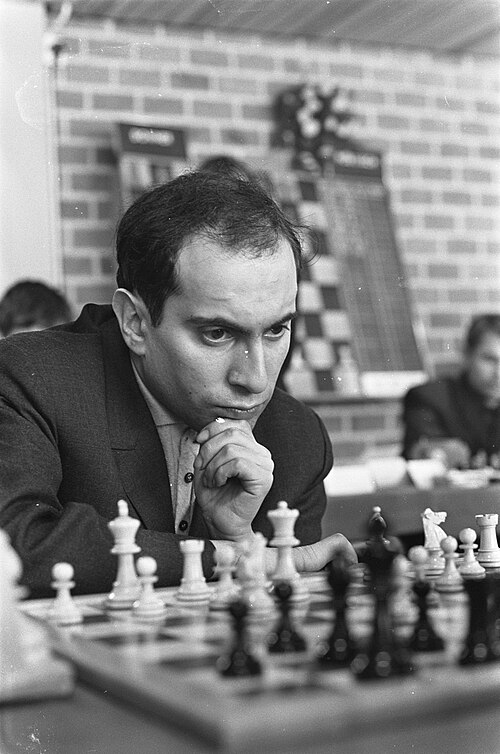
Mikhail Tal was the eighth world chess champion and one of the most exciting attacking players who ever lived. Born in Riga, Latvia, in 1936, he beat Mikhail Botvinnik for the world title in 1960, when he was only 23. Fans called him "the Magician from Riga" because his games looked like magic tricks: he gave away pieces to attack the enemy king, and his opponents often could not find the way out.
Early years in Riga
Tal was born on 9 November 1936 in Riga, then the capital of an independent Latvia. As a boy he joined the chess club at the city's Palace of Young Pioneers, a free club for children. He improved very fast. In 1957, aged 20, he won the Soviet Championship, at that time one of the strongest tournaments in the world. The same year FIDE (the World Chess Federation) gave him the grandmaster title, the highest title in chess. He won the Soviet Championship again in 1958.
World champion at 23
To challenge the champion, a player first had to win the Candidates tournament, the event that picks the challenger. Tal won the 1959 Candidates in Yugoslavia, ahead of Paul Keres, Tigran Petrosian, Vasily Smyslov and a 16-year-old Bobby Fischer.
In 1960 he met Mikhail Botvinnik in Moscow. Botvinnik was a careful, scientific player, so the match was a clash of styles. Tal won 12½–8½, with six wins, two losses and thirteen draws. At 23 he was the youngest world champion so far. Garry Kasparov later broke that record, and Gukesh Dommaraju broke it again in 2024.
The rules of the time gave Botvinnik a return match. He studied Tal's games closely and steered the 1961 rematch into slow, quiet positions. Botvinnik won 13–8, and Tal's reign was over after about a year.
Illness and a long career
Tal had serious kidney problems for most of his adult life and spent long periods in hospital; one kidney was removed in 1969. Even so, he stayed close to the top for three decades. He won the Soviet Championship six times in all (1957, 1958, 1967, 1972, 1974 and 1978). In 1973–74 he played 95 games in a row without a loss, a record at the time. He won the 1979 Riga Interzonal, a qualifying tournament for the world title, and in 1988, aged 51, he won the World Blitz Championship. Blitz is very fast chess, with only a few minutes per player for the whole game.
In May 1992 he left hospital to play a blitz tournament in Moscow and beat Garry Kasparov there. He died in a Moscow hospital a month later, on 28 June 1992, aged 55.
How Tal played
Tal loved the sacrifice: giving up material on purpose to get something better, such as an attack on the king or more active pieces. Many of his sacrifices were not "sound". That means a perfect defender, or a modern computer, could find a way to survive. But at the board, with the clock ticking, defending against Tal was very hard. He trusted his imagination and his calculation, and he aimed for positions full of threats.
Players like Botvinnik or Anatoly Karpov won by slowly collecting small advantages. Tal did the opposite. He made the position wild and dared his opponent to keep up. If you enjoy this style, the sacrifice puzzles are a good way to train your eye for such ideas.
Famous game: Botvinnik vs Tal, game 6, 1960
The sixth game of the 1960 match shows Tal at his most daring. He had Black and played the King's Indian Defence, an opening where Black lets White build a big centre and then fights back. After 21 moves the position looked calm. Then Tal put his knight on f4, where a white pawn could simply take it.
Botvinnik took the knight. Tal recaptured with a pawn, which opened the long diagonal for his bishop on g7, and his queen grabbed White's pawn on b2. Then he pushed his f-pawn forward to attack White's queen. After the queens were exchanged, Tal had a pawn on e2, just one square away from becoming a new queen.
White had to use time and pieces to deal with that pawn, and Tal soon won back his material. He went on to win a long endgame. You can replay the whole game on the analysis board and try to find White's defences for yourself.
Legacy
Tal showed that chess can be an art of bold ideas, not only careful science. Two well-known collections of brilliant games, The Mammoth Book of the World's Greatest Chess Games and Modern Chess Brilliancies, include more games by Tal than by any other player. Strong players still say someone is "playing like Tal" when pieces start flying towards the enemy king. Engines can now check every one of his sacrifices, but his games remain a joy to replay. See where he stands among all the title holders on our World Chess Champions page, and read about his great opponent Mikhail Botvinnik.
Sources
- Mikhail Tal, Wikipedia
- World Chess Championship 1960, Wikipedia (match details and the score of game 6)
- Mikhail Tal: Triumph and Tragedy (Part I), ChessBase, 2012
- Clash of Champions: Tal vs. Botvinnik, Chess.com
Checked in November 2026.
Questions and answers
- Why was Mikhail Tal called the Magician from Riga?
- He came from Riga in Latvia, and his attacks were so surprising that they looked like magic tricks. He often sacrificed pieces to create threats that were very hard to answer over the board.
- When was Mikhail Tal world champion?
- From 1960 to 1961. He beat Mikhail Botvinnik 12½–8½ in 1960 and lost the return match 13–8 a year later.
- Were Tal's sacrifices always correct?
- No. Some of them could be refuted with perfect defence, which modern engines can find. But in a real game, with the clock running, his opponents usually could not find that defence.
- How old was Mikhail Tal when he died?
- He died in Moscow on 28 June 1992, aged 55, after many years of kidney illness.
Play free now — no sign-up needed